
THE ARGUMENT
- 01
Which resource is allocated?
A cargo recommendation may inform demand, inventory or overbooking. Training scheduling allocates instructors and facilities.
- 02
What constraints enter the recommendation?
State the capacity, resource and operating constraints that shape a recommendation. Keep the covered routes, modules and decisions explicit.
- 03
Where is human confirmation required?
Locate the handoff where a recommendation becomes an accepted commitment. Preserve the responsible role, checks, overrides and rejection path.
- 04
What is the net service result?
Compare completed service under comparable workload and constraints. Include manual repair, repeated planning, exceptions and the full delivery cost.
THE EXECUTIVE VIEW
A better recommendation matters only when it changes allocation within real operating constraints.
01 / A better recommendation matters only when it changes allocation within real operating constraints.
02 / Identify who accepts the recommendation, what is checked, how an override is recorded and what follows rejection. Coverage should describe relevant routes, modules or decisions, rather than parent-company size.
03 / The planning owner should select one allocation decision with a clear comparison boundary. Operations should identify where a plan becomes an accepted commitment. Evaluation should retain rejected recommendations and disruption cases alongside normal work.
AI-assisted, bounded public-source research. Purposefully selected entity scopes; no company participation, endorsement, independent assurance or population inference implied. Confidential assessment is in development.
Recorded source dates run from 2021-10-31 to 2026-09-28. 9 of 32 qualifying claim records have no recorded publication date. This is not a common observation window or confirmation of continuing use.
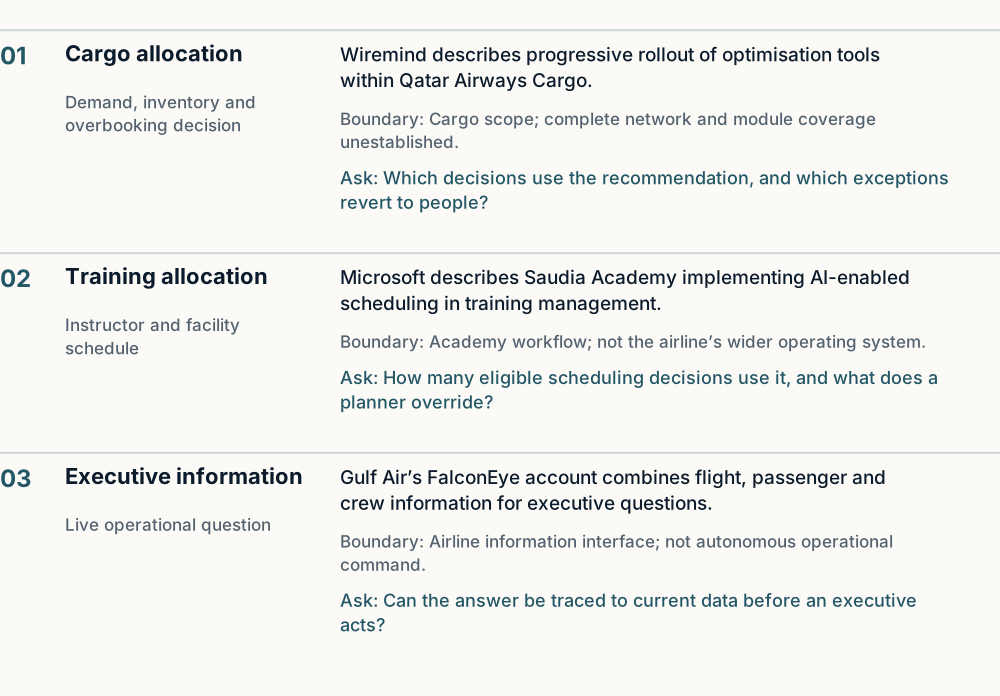
Cargo, training and executive information involve different decisions
Three separate allocation and information workflows; coverage must follow the named operation.
Read the exhibit in text
Cargo allocation
Source account: Wiremind describes progressive rollout of optimisation tools within Qatar Airways Cargo.
Boundary: Cargo scope; complete network and module coverage unestablished.
Question: Which decisions use the recommendation, and which exceptions revert to people?
Qatar Airways Cargo goes live with CARGOSTACK Optimiser ↗Training allocation
Source account: Microsoft describes Saudia Academy implementing AI-enabled scheduling in training management.
Boundary: Academy workflow; not the airline’s wider operating system.
Question: How many eligible scheduling decisions use it, and what does a planner override?
Saudia Academy transforms aviation training with Dynamics 365 ↗Executive information
Source account: Gulf Air’s FalconEye account combines flight, passenger and crew information for executive questions.
Boundary: Airline information interface; not autonomous operational command.
Question: Can the answer be traced to current data before an executive acts?
Public preview: Voice-native agents in Microsoft Foundry ↗Public preview: Voice-native agents in Microsoft Foundry ↗Basis: attributed-account. Unit: Separate source-described operating cases. Cutoff: 2026-10-10. Company and supplier accounts are attributed descriptions, not independent assurance. Each row describes a different operating task; no company comparison or rating is intended.
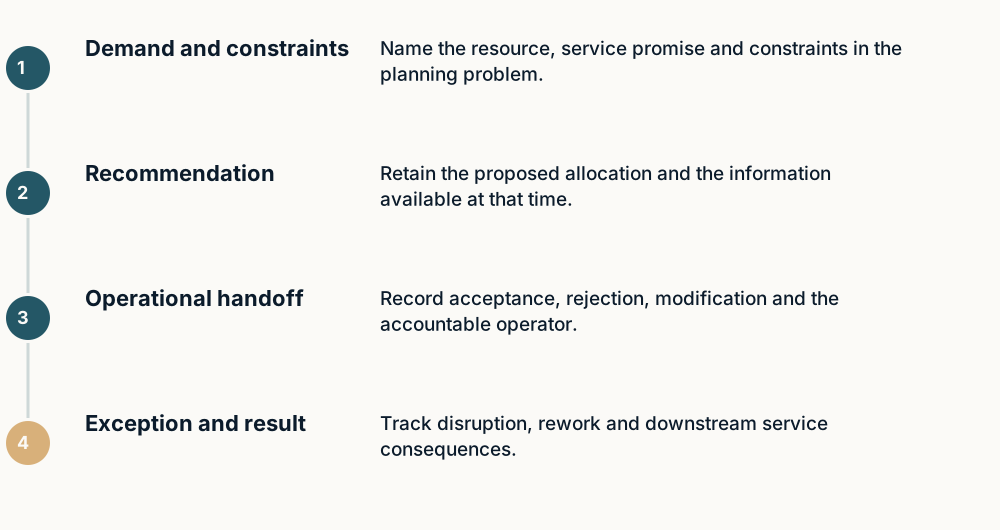
Trace the recommendation to the operational handoff
Mayden analytical framework / questions to test, not measured maturity stages
Read the exhibit in text
Demand and constraints
Name the resource, service promise and constraints in the planning problem.
Recommendation
Retain the proposed allocation and the information available at that time.
Operational handoff
Record acceptance, rejection, modification and the accountable operator.
Exception and result
Track disruption, rework and downstream service consequences.
Basis: conceptual-tool. Unit: Conceptual decision or evidence request. Cutoff: 2026-10-10. Mayden conceptual framework. These questions specify evidence to request; they do not assert that a named organisation has or lacks the practice. This is not a validated instrument or an observed causal sequence.
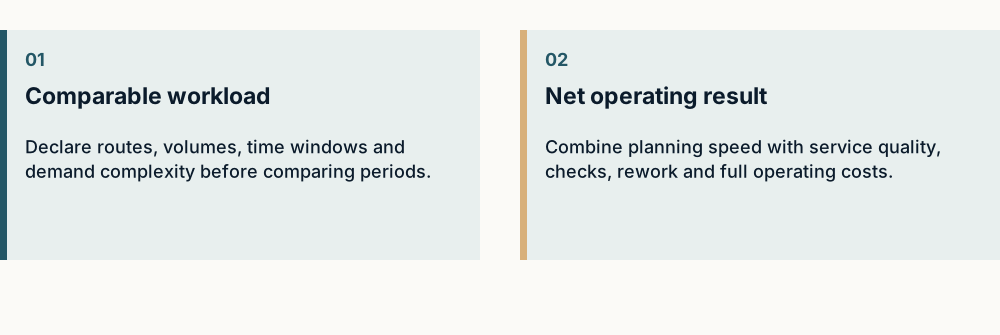
A faster plan needs a service and rework denominator
Mayden analytical framework / questions to test, not measured maturity stages
Read the exhibit in text
Comparable workload
Declare routes, volumes, time windows and demand complexity before comparing periods.
Net operating result
Combine planning speed with service quality, checks, rework and full operating costs.
Basis: conceptual-tool. Unit: Conceptual decision or evidence request. Cutoff: 2026-10-10. Mayden conceptual framework. These questions specify evidence to request; they do not assert that a named organisation has or lacks the practice. This is not a validated instrument or an observed causal sequence.
A better recommendation matters only when it changes allocation within real operating constraints.
AI creates a practical question in aviation and logistics: which allocation changes because of the recommendation? Cargo space, instructor time and operational information do not share a single performance denominator. Follow the handoff from an output to an accepted operating decision.
Identify the scarce resource
A cargo recommendation may inform demand, inventory or overbooking. Training scheduling allocates instructors and facilities. Executive information can assemble a view without commanding operations. Define the resource, decision maker and constraints that make the decision consequential.
Keep airline, cargo, academy, airport and group IT boundaries visible. An implementation within one setting does not establish end-to-end autonomy across a transport group.
Trace the handoff, including rejection
Identify who accepts the recommendation, what is checked, how an override is recorded and what follows rejection. Coverage should describe relevant routes, modules or decisions, rather than parent-company size.
The cases below illustrate separate allocation and information workflows. They are not a common performance test. Vendor descriptions can identify a deployment and intended workflow; achieved network-wide value requires a different observation.
Attributed operating examples
These separate cases were selected by the operating question, not company standing. The diagram does not imply one connected system.
Cargo allocation
Wiremind describes progressive rollout of optimisation tools within Qatar Airways Cargo. Cargo scope; complete network and module coverage unestablished. The next research question is: Which decisions use the recommendation, and which exceptions revert to people?
Source: Qatar Airways Cargo goes live with CARGOSTACK Optimiser ↗.
Training allocation
Microsoft describes Saudia Academy implementing AI-enabled scheduling in training management. Academy workflow; not the airline’s wider operating system. The next research question is: How many eligible scheduling decisions use it, and what does a planner override?
Source: Saudia Academy transforms aviation training with Dynamics 365 ↗.
Executive information
Gulf Air’s FalconEye account combines flight, passenger and crew information for executive questions. Airline information interface; not autonomous operational command. The next research question is: Can the answer be traced to current data before an executive acts?
Source: Public preview: Voice-native agents in Microsoft Foundry ↗.
Evaluate service, constraints and rework together
A faster schedule is useful only if it remains workable. Define the comparison period, workload, constraints, service outcomes and downstream effort. Count manual repair, repeated planning and exceptions. Preserve model and policy changes so apparent improvement does not conceal a different task.
Agent benchmark research warns that an expected final state need not demonstrate that intermediate actions followed policy. Synthetic airline tasks are not carrier-performance evidence, but motivate inspecting the route as well as the outcome. tau-bench: A Benchmark for Tool-Agent-User Interaction in Real-World Domains ↗.
Create a repeatable operating record
The planning owner should select one allocation decision with a clear comparison boundary. Operations should identify where a plan becomes an accepted commitment. Evaluation should retain rejected recommendations and disruption cases alongside normal work.
A future diagnostic can return a bounded priority: improve evidence around a handoff, clarify responsibility or test an expansion. It should not extrapolate one scheduling application into a company-wide label or promise a financial result without compatible data.
Leadership agenda
Planning: identify one allocation decision and its binding constraints.
Operations: trace recommendation, acceptance, override and completed service.
Evaluation: retain disruption cases, rework and the full planning cost.
Scope and reading boundaries
The source corpus contains 80 purposefully selected entity records across eight sectors, ten per sector. Headquarters markets are Saudi Arabia, the UAE, Qatar, Kuwait and Bahrain; Oman is outside this edition. Groups, subsidiaries and specific operations have different scopes. This is not a representative sample. Source cutoff: 10 October 2026; publication edition: 11 October 2026.
Source extraction and challenge were AI-assisted, not independent human assurance or verification of current operations. Source visibility is not adoption prevalence. Unreported details are unresolved questions, not absent capabilities. Named examples imply neither participation, endorsement, confidential access nor a Mayden client relationship.
A CLOSER LOOK
Cargo allocation
Demand, inventory and overbooking decision
Qatar Airways Cargo went live with CARGOSTACK Optimiser, gradually rolling out demand, inventory and overbooking optimization.
Boundary. Cargo scope; complete network and module coverage unestablished.
Source date. 2024-11-06
Locator. Go-live paragraph and phased implementation details Inspect source ↗
The leadership question
Which decisions use the recommendation, and which exceptions revert to people?
Cargo scope; complete network and module coverage unestablished.
Training allocation
Instructor and facility schedule
Saudia Academy implemented AI-enabled scheduling in its training-management system, supporting instructor and facility allocation.
Boundary. Academy workflow; not the airline’s wider operating system.
Source date. 2024-06-20
Locator. Technology implementation and instructor scheduling passages Inspect source ↗
The leadership question
How many eligible scheduling decisions use it, and what does a planner override?
Academy workflow; not the airline’s wider operating system.
Executive information
Live operational question
Gulf Air FalconEye provides executives conversational access to live operations and voice commands that open dashboards.
Boundary. Airline information interface; not autonomous operational command.
Source date. 2026-03-16
Locator. Customer example: Gulf Air FalconEye and Ahmed Naeemi statement Inspect source ↗
FalconEye combines flight, passenger, crew and other operating information for executive questions.
Boundary. Airline information interface; not autonomous operational command.
Source date. 2026-03-16
Locator. Gulf Air FalconEye customer example Inspect source ↗
The leadership question
Can the answer be traced to current data before an executive acts?
Airline information interface; not autonomous operational command.
THE LEADERSHIP AGENDA
Ask for evidence that changes the decision.
01 / Planning
Evidence to request: identify one allocation decision and its binding constraints.
02 / Operations
Evidence to request: trace recommendation, acceptance, override and completed service.
03 / Evaluation
Evidence to request: retain disruption cases, rework and the full planning cost.
Follow the argument back to its source.
Sources supporting the argument and its examples. Corporate accounts are attributed; inclusion does not imply participation, endorsement or independent operating verification.
S01 / Qatar Airways Cargo goes live with CARGOSTACK Optimiser
Wiremind · 2024-11-06 · official-partner-publication
Locator: Go-live paragraph and phased implementation details
Open source ↗S02 / Saudia Academy transforms aviation training with Dynamics 365
Microsoft · 2024-06-20 · official-partner-publication
Locator: Technology implementation and instructor scheduling passages
Open source ↗S03 / Public preview: Voice-native agents in Microsoft Foundry
Microsoft · 2026-03-16 · official-partner-publication
Locator: Customer example: Gulf Air FalconEye and Ahmed Naeemi statement
Open source ↗S04 / tau-bench: A Benchmark for Tool-Agent-User Interaction in Real-World Domains
Author preprint / Sierra research · 2024-06-17 · original-benchmark-preprint
Locator: Synthetic interactive agent benchmark with repeated trials
Open source ↗Aggregate chart inputs are available in the current public dataset. The underlying company coding remains private; earlier published calculations are explicitly archived. Download the designed PDF ↓