
THE ARGUMENT
- 01
What activity is reported?
Documentation, image interpretation and screening coordination change different work. Specify provider, service, patient population, professional role and period.
- 02
What exactly was evaluated?
The AIRIS-TB paper evaluates 1.04 million chest X-rays from January 2022 to January 2024 in an observational retrospective analysis in Abu Dhabi. Projected reporting reduction is calculated from classifications, not demonstrated prospective staffing savings.
- 03
Who retains clinical authority?
Final authority should be observable in an accepted or rejected output, correction and follow-up. For documentation, ask who verifies the note and how errors are corrected.
- 04
What would justify a new setting or population?
Clinical, operational and technical reviewers should agree intended use, comparator, period and outcome definitions before collection. Include verification burden and subgroup performance where appropriate.
THE EXECUTIVE VIEW
Operating throughput, retrospective evaluation and clinical authority are separate lines of evidence.
01 / Operating throughput, retrospective evaluation and clinical authority are separate lines of evidence.
02 / The AIRIS-TB paper evaluates 1.04 million chest X-rays from January 2022 to January 2024 in an observational retrospective analysis in Abu Dhabi. Projected reporting reduction is calculated from classifications, not demonstrated prospective staffing savings. External-dataset performance and restricted sputum-confirmation pathways limit generalisation. M42/CHSC affiliations and model-developer involvement remain relevant. [Population-scale cross-sectional observational study for AI-powered TB screening on one million CXRs](https://pmc.ncbi.nlm.nih.gov/articles/PMC12241593/).
03 / Clinical, operational and technical reviewers should agree intended use, comparator, period and outcome definitions before collection. Include verification burden and subgroup performance where appropriate. Preserve disputed outputs and corrections.
AI-assisted, bounded public-source research. Purposefully selected entity scopes; no company participation, endorsement, independent assurance or population inference implied. Confidential assessment is in development.
Recorded source dates run from 2024-12-30 to 2025-08-06. 22 of 27 qualifying claim records have no recorded publication date. This is not a common observation window or confirmation of continuing use.
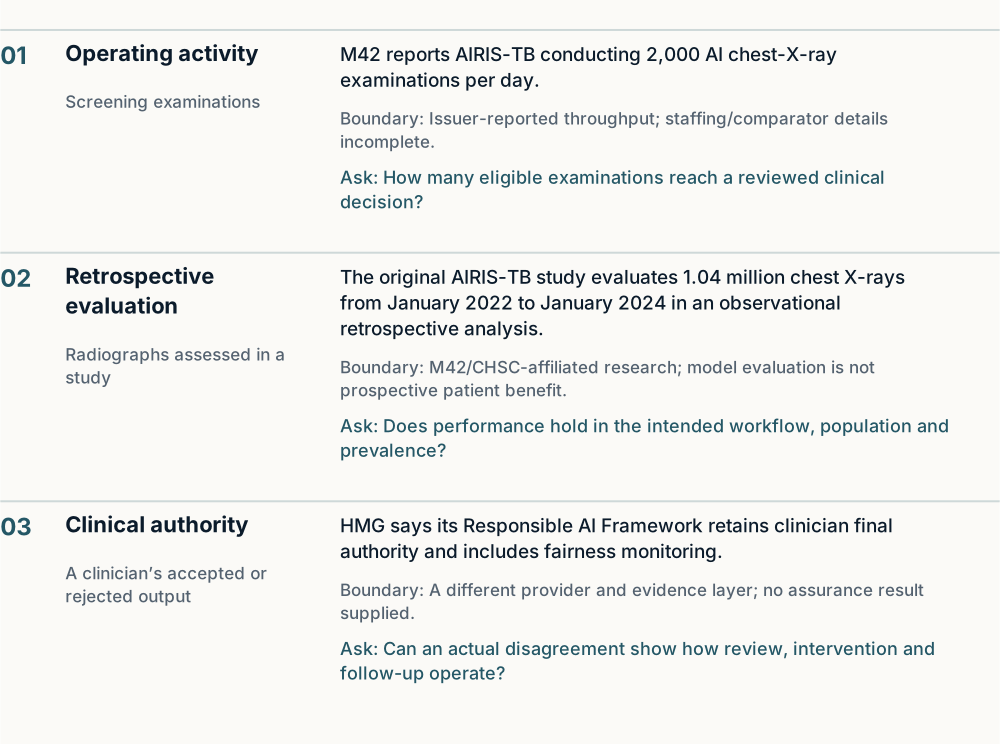
Do not put throughput and evaluation size on the same axis
Activity, model evaluation and clinical authority answer different questions. Cases are not pooled into a clinical-quality score.
Read the exhibit in text
Operating activity
Source account: M42 reports AIRIS-TB conducting 2,000 AI chest-X-ray examinations per day.
Boundary: Issuer-reported throughput; staffing/comparator details incomplete.
Question: How many eligible examinations reach a reviewed clinical decision?
M42 and GE HealthCare join forces to advance AI-Enabled Patient Care ↗Retrospective evaluation
Source account: The original AIRIS-TB study evaluates 1.04 million chest X-rays from January 2022 to January 2024 in an observational retrospective analysis.
Boundary: M42/CHSC-affiliated research; model evaluation is not prospective patient benefit.
Question: Does performance hold in the intended workflow, population and prevalence?
M42 announces breakthrough results for its AI-powered tuberculosis screening ↗Population-scale cross-sectional observational study for AI-powered TB screening on one million CXRs ↗Clinical authority
Source account: HMG says its Responsible AI Framework retains clinician final authority and includes fairness monitoring.
Boundary: A different provider and evidence layer; no assurance result supplied.
Question: Can an actual disagreement show how review, intervention and follow-up operate?
Annual Report 2025 ↗Basis: attributed-account. Unit: Separate source-described operating cases. Cutoff: 2026-10-10. Company and supplier accounts are attributed descriptions, not independent assurance. Each row describes a different operating task; no company comparison or rating is intended.
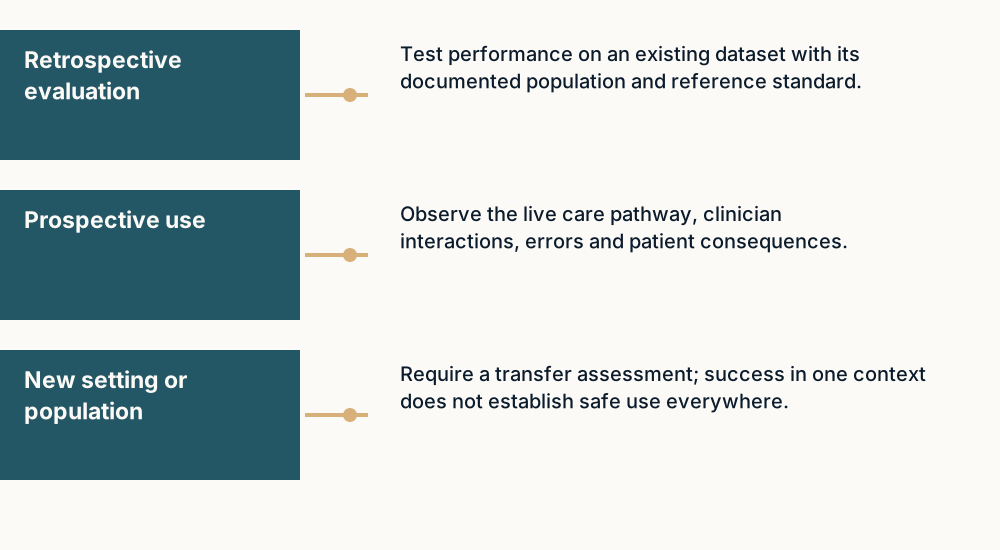
A study's operating boundary matters as much as its sample size
Mayden analytical framework / questions to test, not measured maturity stages
Read the exhibit in text
Retrospective evaluation
Test performance on an existing dataset with its documented population and reference standard.
Prospective use
Observe the live care pathway, clinician interactions, errors and patient consequences.
New setting or population
Require a transfer assessment; success in one context does not establish safe use everywhere.
Basis: conceptual-tool. Unit: Conceptual decision or evidence request. Cutoff: 2026-10-10. Read each study with its original setting, reference standard, observation period and limits. Missing details remain unknown. This is a conceptual appraisal framework, not an assurance of clinical safety.
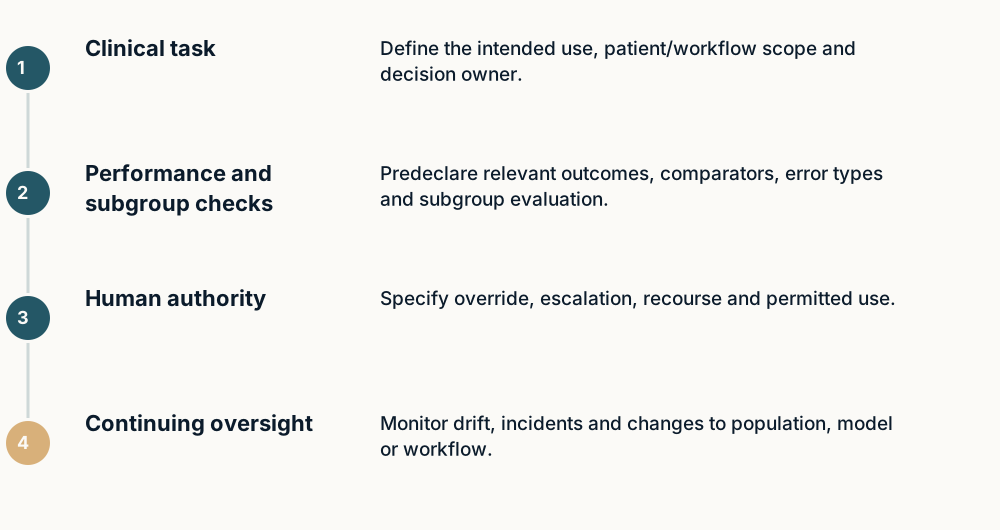
Keep the clinical decision visible in the workflow
Mayden analytical framework / questions to test, not measured maturity stages
Read the exhibit in text
Clinical task
Define the intended use, patient/workflow scope and decision owner.
Performance and subgroup checks
Predeclare relevant outcomes, comparators, error types and subgroup evaluation.
Human authority
Specify override, escalation, recourse and permitted use.
Continuing oversight
Monitor drift, incidents and changes to population, model or workflow.
Basis: conceptual-tool. Unit: Conceptual decision or evidence request. Cutoff: 2026-10-10. Mayden conceptual framework. These questions specify evidence to request; they do not assert that a named organisation has or lacks the practice. This is not a validated instrument or an observed causal sequence.
Operating throughput, retrospective evaluation and clinical authority are separate lines of evidence.
Healthcare AI needs distinct evidence layers: a system may process examinations, perform well retrospectively and still need separate evidence of benefit in a live pathway. Mayden follows the workflow and accountable clinical decision; this is not a clinical-quality rating.
Identify the clinical and organisational question
Documentation, image interpretation and screening coordination change different work. Specify provider, service, patient population, professional role and period. A company-wide statement cannot establish suitability for every clinical use.
Throughput describes activity. Retrospective performance describes evaluation under a study design. Prospective effects on care, workload and safety need further observations. A technical result should not carry a broader claim than its evidence supports.
Read the study in its actual setting
The AIRIS-TB paper evaluates 1.04 million chest X-rays from January 2022 to January 2024 in an observational retrospective analysis in Abu Dhabi. Projected reporting reduction is calculated from classifications, not demonstrated prospective staffing savings. External-dataset performance and restricted sputum-confirmation pathways limit generalisation. M42/CHSC affiliations and model-developer involvement remain relevant. Population-scale cross-sectional observational study for AI-powered TB screening on one million CXRs ↗.
This is locally relevant research, not an enterprise-capability measure or proof of a new deployment’s effect in another population. The accompanying cases concern distinct evidence layers and must not be pooled into a provider comparison.
Attributed operating examples
These separate cases were selected by the operating question, not company standing. The diagram does not imply one connected system.
Operating activity
M42 reports AIRIS-TB conducting 2,000 AI chest-X-ray examinations per day. Issuer-reported throughput; staffing/comparator details incomplete. The next research question is: How many eligible examinations reach a reviewed clinical decision?
Source: M42 and GE HealthCare join forces to advance AI-Enabled Patient Care ↗.
Retrospective evaluation
The original AIRIS-TB study evaluates 1.04 million chest X-rays from January 2022 to January 2024 in an observational retrospective analysis. M42/CHSC-affiliated research; model evaluation is not prospective patient benefit. The next research question is: Does performance hold in the intended workflow, population and prevalence?
Source: M42 announces breakthrough results for its AI-powered tuberculosis screening ↗.
Clinical authority
HMG says its Responsible AI Framework retains clinician final authority and includes fairness monitoring. A different provider and evidence layer; no assurance result supplied. The next research question is: Can an actual disagreement show how review, intervention and follow-up operate?
Source: Annual Report 2025 ↗.
Evaluate the combined workflow
Final authority should be observable in an accepted or rejected output, correction and follow-up. For documentation, ask who verifies the note and how errors are corrected. For screening, trace the output to a reviewed decision and identify eligible examinations outside the workflow. These are research questions, not treatment recommendations.
A randomised study of 50 physicians found no significant improvement in its primary diagnostic-reasoning score from chatbot access. It used vignettes, not patient outcomes. This illustrates why the combined workflow needs evaluation; it does not settle the value of other systems. Large Language Model Influence on Diagnostic Reasoning: A Randomized Clinical Trial ↗.
Keep the next study accountable
Clinical, operational and technical reviewers should agree intended use, comparator, period and outcome definitions before collection. Include verification burden and subgroup performance where appropriate. Preserve disputed outputs and corrections.
The future company diagnostic requires qualified human review and permissioned evidence. It must not award clinical assurance, infer patient benefit from disclosure volume or interpret limited public detail as unsafe care.
Leadership agenda
Clinical owner: define intended use, population and final authority.
Operations: measure eligible work, reviewed outputs and correction effort.
Research reviewer: separate retrospective performance, projected effects and observed workflow outcomes.
Scope and reading boundaries
The source corpus contains 80 purposefully selected entity records across eight sectors, ten per sector. Headquarters markets are Saudi Arabia, the UAE, Qatar, Kuwait and Bahrain; Oman is outside this edition. Groups, subsidiaries and specific operations have different scopes. This is not a representative sample. Source cutoff: 10 October 2026; publication edition: 11 October 2026.
Source extraction and challenge were AI-assisted, not independent human assurance or verification of current operations. Source visibility is not adoption prevalence. Unreported details are unresolved questions, not absent capabilities. Named examples imply neither participation, endorsement, confidential access nor a Mayden client relationship.
A CLOSER LOOK
Operating activity
Screening examinations
M42 reports AIRIS-TB conducting 2,000 AI chest X-ray examinations daily.
Boundary. Issuer-reported throughput; staffing/comparator details incomplete.
Source date. 2025-07-08
Locator. Final AIRIS-TB paragraph, line69 Inspect source ↗
The leadership question
How many eligible examinations reach a reviewed clinical decision?
Issuer-reported throughput; staffing/comparator details incomplete.
Retrospective evaluation
Radiographs assessed in a study
M42 reports AIRIS-TB validation using more than 1 million screening radiographs and demographic performance checks.
Boundary. M42/CHSC-affiliated research; model evaluation is not prospective patient benefit.
Source date. 2025-08-06
Locator. Study design, results and demographic consistency paragraphs Inspect source ↗
The leadership question
Does performance hold in the intended workflow, population and prevalence?
M42/CHSC-affiliated research; model evaluation is not prospective patient benefit.
Clinical authority
A clinician’s accepted or rejected output
HMG reports a Responsible AI Framework with clinician final authority, security requirements and fairness monitoring.
Boundary. A different provider and evidence layer; no assurance result supplied.
Source date. Undated
Locator. PDF39/printed 75–76, Applying Responsible AI Inspect source ↗
The leadership question
Can an actual disagreement show how review, intervention and follow-up operate?
A different provider and evidence layer; no assurance result supplied.
THE LEADERSHIP AGENDA
Ask for evidence that changes the decision.
01 / Clinical owner
Evidence to request: define intended use, population and final authority.
02 / Operations
Evidence to request: measure eligible work, reviewed outputs and correction effort.
03 / Research reviewer
Evidence to request: separate retrospective performance, projected effects and observed workflow outcomes.
Follow the argument back to its source.
Sources supporting the argument and its examples. Corporate accounts are attributed; inclusion does not imply participation, endorsement or independent operating verification.
S01 / M42 and GE HealthCare join forces to advance AI-Enabled Patient Care
M42 · 2025-07-08 · official-implementation-account
Locator: Final AIRIS-TB paragraph, line69
Open source ↗S02 / M42 announces breakthrough results for its AI-powered tuberculosis screening
M42 · 2025-08-06 · official-implementation-account
Locator: Study design, results and demographic consistency paragraphs
Open source ↗S03 / Annual Report 2025
HMG · Undated · annual-report
Locator: PDF39/printed 75–76, Applying Responsible AI
Open source ↗S04 / Population-scale cross-sectional observational study for AI-powered TB screening on one million CXRs
npj Digital Medicine; full text in PMC · 2025-07-09 · original-observational-model-evaluation
Locator: Retrospective observational evaluation; authors also describe a quasi-prospective approach.
Open source ↗S05 / Large Language Model Influence on Diagnostic Reasoning: A Randomized Clinical Trial
JAMA Network Open · 2024-10-28 · peer-reviewed-randomized-trial
Locator: Stratified randomised, blinded-rating trial
Open source ↗Aggregate chart inputs are available in the current public dataset. The underlying company coding remains private; earlier published calculations are explicitly archived. Download the designed PDF ↓