التقرير الكامل متاح بالإنجليزية في هذا الإصدار. يستند البحث إلى مصادر منشورة، ولا ينشر درجات فردية للشركات.
THE ARGUMENT
- 01
What becomes visible across the selected corpus?
Observe where qualifying documentation appears across eight selected sector cohorts and nine themes. These are corpus counts, not adoption rates or sector performance ranks.
- 02
Where does a deployment claim stop?
Deployment does not establish current use, operational coverage or useful results. Publication date and confirmation of continuing operation require separate evidence.
- 03
What would establish useful operating change?
Connect the output to an accepted decision, a responsible owner and an observed result. The appropriate work unit and outcome differ by sector; matching headings alone does not establish comparability.
- 04
What should the next research wave measure?
Collect permissioned, scope-consistent operating records with multiple knowledgeable perspectives. Preserve outcomes, review gaps, source dependencies and reasons for change.
THE EXECUTIVE VIEW
Follow the decision, then test the operating change.
01 / Compare operating questions: information, authority, handoffs and observed results. This public edition does not rank companies.
02 / The corpus has 80 selected entity records and 272 recorded claims; 224 meet retained evidence rules. These describe the research collection, not AI prevalence across Gulf businesses.
03 / The atlas supports deeper inquiry. Enterprise benchmarking still needs a defined participating population, permissioned evidence, human review and empirical validation.
AI-assisted, bounded public-source research. Purposefully selected entity scopes; no company participation, endorsement, independent assurance or population inference implied. Confidential assessment is in development.
Recorded source dates run from 2019-05-14 to 2026-10-01. 79 of 224 qualifying claim records have no recorded publication date. This is not a common observation window or confirmation of continuing use.
Evidence is uneven across themes in this selected corpus
Located qualifying evidence / ten selected entity records in each sector
| Selected entity / cohort | AI Core | Augmented Workforce | Ecosystem | Interfaces & Automation | Decision Lineage | Experimentation | Autonomy & Operating Model | Knowledge | Governance | Cohort n |
|---|---|---|---|---|---|---|---|---|---|---|
| Aviation & Logistics | 7 | 3 | 5 | 3 | 1 | 2 | 0 | 2 | 2 | 10 |
| Banking | 7 | 8 | 4 | 7 | 2 | 3 | 2 | 4 | 7 | 10 |
| Energy & Utilities | 7 | 6 | 5 | 3 | 0 | 3 | 1 | 3 | 1 | 10 |
| Healthcare | 6 | 3 | 3 | 4 | 0 | 3 | 0 | 1 | 4 | 10 |
| Manufacturing & Materials | 5 | 2 | 2 | 1 | 0 | 3 | 0 | 2 | 2 | 10 |
| Real Estate & Construction | 4 | 1 | 4 | 3 | 0 | 3 | 1 | 1 | 0 | 10 |
| Retail & Consumer | 3 | 1 | 3 | 5 | 0 | 0 | 1 | 1 | 2 | 10 |
| Telecommunications | 5 | 5 | 3 | 4 | 1 | 2 | 3 | 3 | 3 | 10 |
Basis: corpus-statistic. Unit: Entity-theme cells with located qualifying evidence. Denominator: 10 purposefully selected entity records per sector; 720 total entity-theme cells. Cutoff: 2026-10-10. Counts describe evidence in a heterogeneous selected corpus. They are not comparable sector maturity, national results or adoption prevalence. Company and subsidiary scopes can overlap.
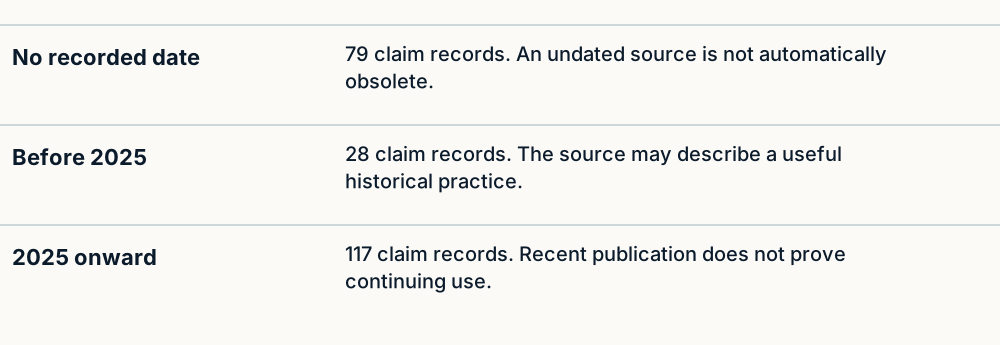
Publication dates are not observations of current use
Source publication dates in the frozen qualifying-claim ledger
Read the exhibit in text
No recorded date
79 claim records. An undated source is not automatically obsolete.
Before 2025
28 claim records. The source may describe a useful historical practice.
2025 onward
117 claim records. Recent publication does not prove continuing use.
Basis: corpus-statistic. Unit: Qualifying claim records. Denominator: 224 claim records; claims can share operating cases. Cutoff: 2026-10-10. Publication date, observation period and confirmation of continuing operation are distinct. These categories do not establish current capability or a common observation window.
Follow the decision, then test the operating change.
Read the atlas as a research collection
The atlas connects eight inquiries: banking; telecoms; energy and utilities; aviation and logistics; manufacturing and materials; retail and consumer; healthcare; real estate and construction. Each contains ten selected entity records. Relevance and identifiable public disclosures influenced purposeful selection. This is not a census or probability sample.
Eighty records create 720 possible entity-theme cells across nine themes. Retained coding contains qualifying evidence in 201 cells; 519 remain unknown in this review. These are documentation counts, not 519 absent capabilities. A source can support several claims or themes; related corporate records can overlap.
Coverage charts count records with qualifying disclosures out of ten selected records per sector. They do not estimate adoption, national performance or which sector is most AI-native. Scope, publication practice and retrieval success can change what is visible.
Separate deployment, use and continuing operation
Of 224 eligible claim records, 79 have no recorded source-publication date, 28 have a date before 2025 and 117 have a date in 2025 or later. These sum to the claim denominator. They are not company, project or independent-confirmation counts. An undated source can discuss a dated reporting period; a recent publication can describe an older implementation.
Deployment does not establish how much eligible work uses a system today. Continuing-use evidence needs a dated observation of the operation. A source-date filter can expose dependence on older documentation, but cannot show that an earlier practice stopped.
Later editions must distinguish discovery from operating change. Access recovery, coding correction, changed corporate scope and revised questions need separate change records.
Ask a different first question in each sector
In banking, trace information and authority. In telecoms, locate where the observation-to-action loop closes. In energy, distinguish prediction from physical-process control. In logistics, identify allocation and constraints.
In manufacturing, connect detection to intervention. In retail, follow exceptions until work finishes. In healthcare, separate activity, model evaluation and clinical consequences. In real estate, locate asset, operating entity and period. These distinctions draw on attributed cases and Mayden’s synthesis; they are not estimated maturity stages.
A common research record can still capture work unit, accountable role, actual use, authority, result and period. Sector modules ask what those fields mean in context. Comparability must be tested, not assumed because headings match.
Make the next edition answer a stronger question
A broader public crawl could improve discovery and repeatability. It cannot reveal confidential operations or remove disclosure bias. The existing collector is a bounded public-source checker; retrieval and text matches create leads, not accepted operating claims.
Next work includes reconciling source families and cases, resolving review gaps, testing the candidate construct with knowledgeable humans and designing permissioned fieldwork. Multi-informant records should preserve disagreement. Outcomes should include checking and rework; later Mayden advisory work must be recorded as a possible influence on change.
Publish bounded findings, including nulls and unresolved questions. Return specific priorities privately to participants. Benchmark status must be earned through usefulness, repeat participation, stable methods and validation; collection size and visual finish do not establish it.
Leadership agenda
Board: ask for the operating boundary behind each headline claim.
Research: improve source dependencies and continuity evidence before expanding numerical claims.
Programme owner: fund the next wave and human review before promising an annual benchmark.
Scope and reading boundaries
The source corpus contains 80 purposefully selected entity records across eight sectors, ten per sector. Headquarters markets are Saudi Arabia, the UAE, Qatar, Kuwait and Bahrain; Oman is outside this edition. Groups, subsidiaries and specific operations have different scopes. This is not a representative sample. Source cutoff: 10 October 2026; publication edition: 11 October 2026.
Source extraction and challenge were AI-assisted, not independent human assurance or verification of current operations. Source visibility is not adoption prevalence. Unreported details are unresolved questions, not absent capabilities. Named examples imply neither participation, endorsement, confidential access nor a Mayden client relationship.
Corpus provenance: Mayden aggregate research inputs ↗ and public methodology ↗. Operating synthesis is developed in the banking report ↗, healthcare report ↗ and full research collection ↗. These are Mayden analytical outputs from the same selected corpus, not independent corroboration.
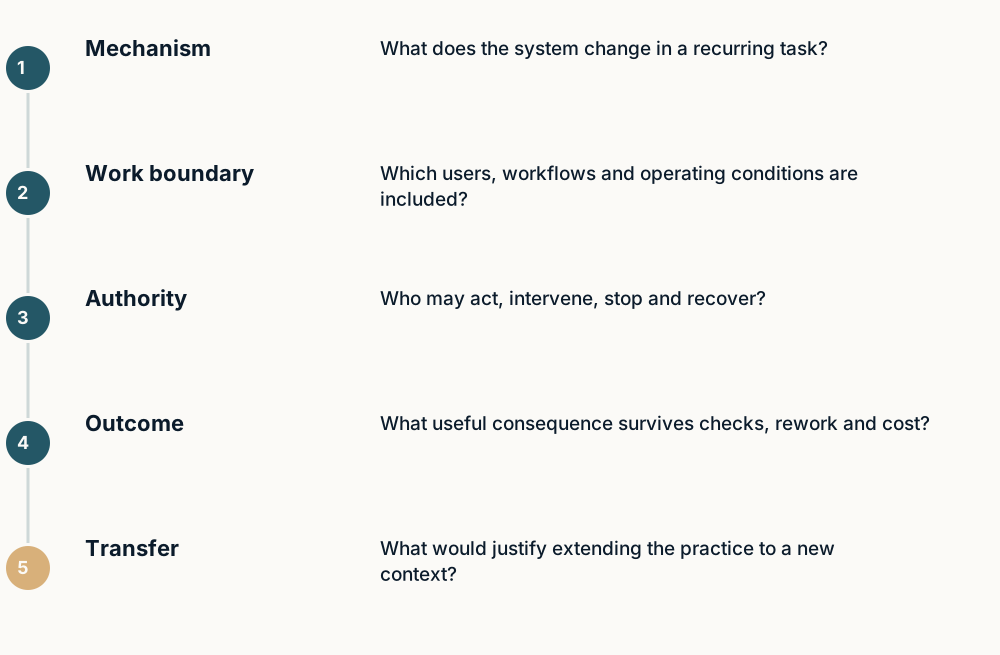
Five gates separate a demonstration from an enterprise result
Mayden analytical framework / questions to test, not measured maturity stages
Read the exhibit in text
Mechanism
What does the system change in a recurring task?
Work boundary
Which users, workflows and operating conditions are included?
Authority
Who may act, intervene, stop and recover?
Outcome
What useful consequence survives checks, rework and cost?
Transfer
What would justify extending the practice to a new context?
Basis: conceptual-tool. Unit: Conceptual decision or evidence request. Cutoff: 2026-10-10. Mayden conceptual framework. These questions specify evidence to request; they do not assert that a named organisation has or lacks the practice. This is not a validated instrument or an observed causal sequence.
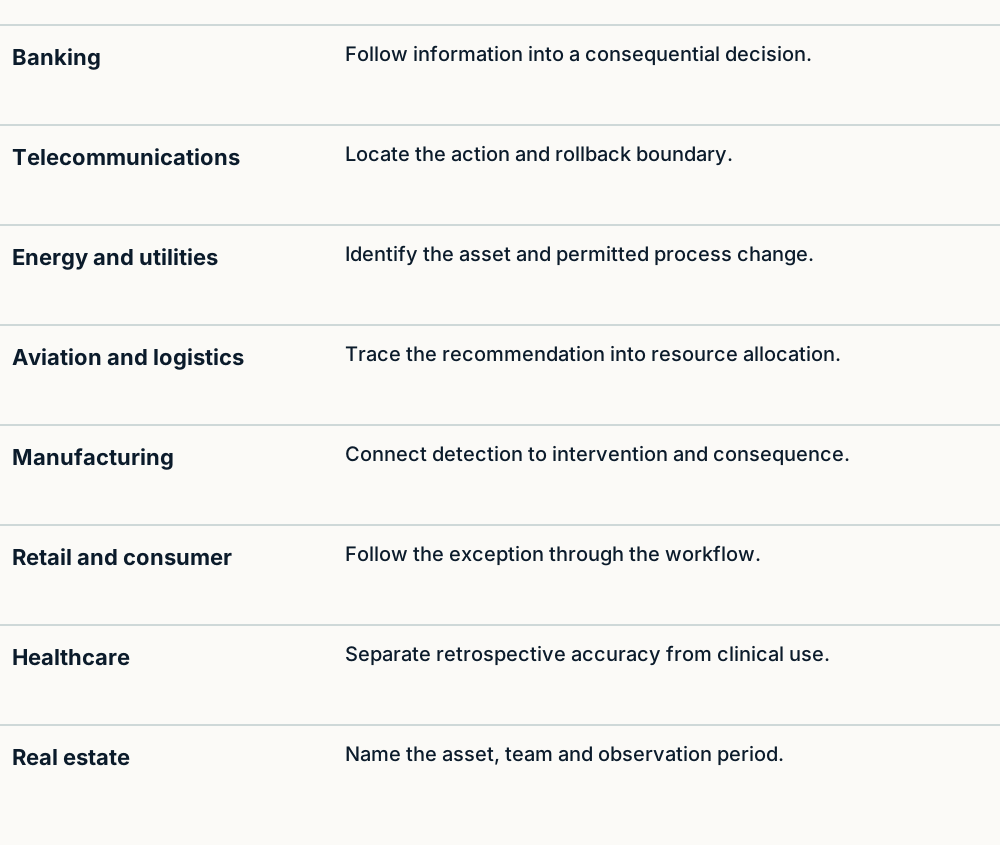
Eight sectors need different first questions
Mayden analytical framework / questions to test, not measured maturity stages
Read the exhibit in text
Banking
Follow information into a consequential decision.
Telecommunications
Locate the action and rollback boundary.
Energy and utilities
Identify the asset and permitted process change.
Aviation and logistics
Trace the recommendation into resource allocation.
Manufacturing
Connect detection to intervention and consequence.
Retail and consumer
Follow the exception through the workflow.
Healthcare
Separate retrospective accuracy from clinical use.
Real estate
Name the asset, team and observation period.
Basis: conceptual-tool. Unit: Conceptual decision or evidence request. Cutoff: 2026-10-10. Mayden conceptual framework. These questions specify evidence to request; they do not assert that a named organisation has or lacks the practice. This is not a validated instrument or an observed causal sequence.
THE LEADERSHIP AGENDA
Ask for evidence that changes the decision.
01 / Board
Evidence to request: ask for the operating boundary behind each headline claim.
02 / Research
Evidence to request: improve source dependencies and continuity evidence before expanding numerical claims.
03 / Programme owner
Evidence to request: fund the next wave and human review before promising an annual benchmark.
Follow the argument back to its source.
Sources supporting the argument and its examples. Corporate accounts are attributed; inclusion does not imply participation, endorsement or independent operating verification.
S01 / Mayden aggregate research inputs
Mayden · 2026-10-11 · Mayden original research / same selected corpus; not independent corroboration
Locator: Same-corpus aggregate data, methodological disclosure or linked sector synthesis; follow the named section in the report
Open source ↗S02 / public methodology
Mayden · 2026-10-11 · Mayden original research / same selected corpus; not independent corroboration
Locator: Same-corpus aggregate data, methodological disclosure or linked sector synthesis; follow the named section in the report
Open source ↗S03 / banking report
Mayden · 2026-10-11 · Mayden original research / same selected corpus; not independent corroboration
Locator: Same-corpus aggregate data, methodological disclosure or linked sector synthesis; follow the named section in the report
Open source ↗S04 / healthcare report
Mayden · 2026-10-11 · Mayden original research / same selected corpus; not independent corroboration
Locator: Same-corpus aggregate data, methodological disclosure or linked sector synthesis; follow the named section in the report
Open source ↗S05 / full research collection
Mayden · 2026-10-11 · Mayden original research / same selected corpus; not independent corroboration
Locator: Same-corpus aggregate data, methodological disclosure or linked sector synthesis; follow the named section in the report
Open source ↗Aggregate chart inputs are available in the current public dataset. The underlying company coding remains private; earlier published calculations are explicitly archived. Download the designed PDF ↓