رؤى / تقرير بحثي
المؤسسة القائمة على الذكاء الاصطناعي تبدأ من العمل
لماذا تكون نتيجة العميل المكتملة هي وحدة التحول
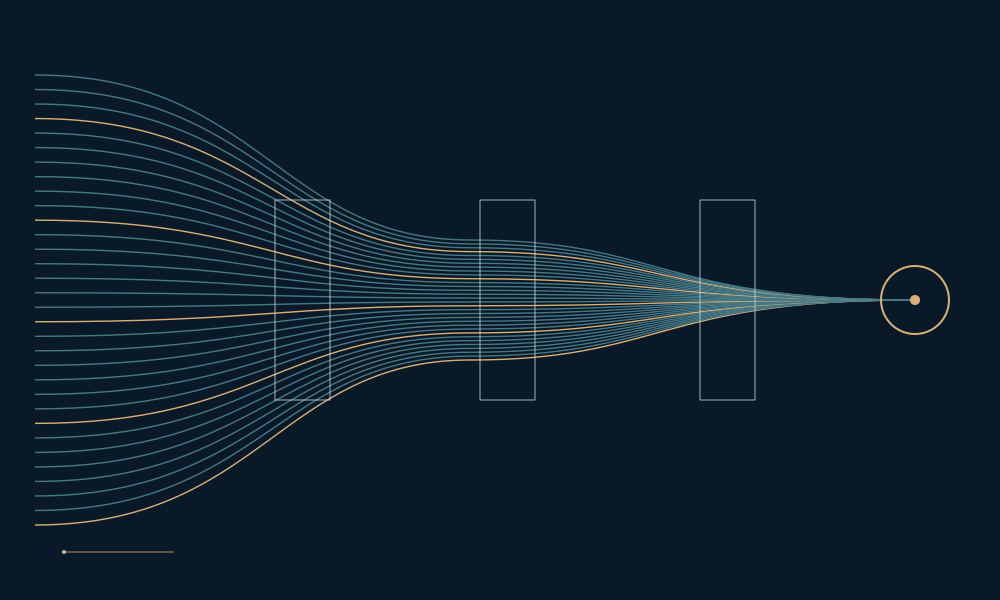
توليف للمصادر الأولية وتحليل mayden. المنهج والحدود موضحان.
الملخص التنفيذي
- تتحول سرعة المهام إلى قيمة عندما تتحسن النتيجة التي يقبلها العميل.
- يجب ربط النتيجة بعنق الزجاجة وصاحب صلاحية تغيير العملية.
- ابدأ بإعادة تصميم محددة وقابلة للقياس مع مسار واضح للاستثناءات.
اقرأ التقرير الكامل بالإنجليزية
يتوفر الملخص التنفيذي بالعربية. يتضمن التقرير الإنجليزي التحليل الكامل والرسوم التوضيحية والأسئلة القيادية والمراجع.
قراءة التقرير بالإنجليزيةتنزيل التقريرمنهج البحث وحدوده
كيفية قراءة هذا البحث
تفاصيل المنهج والمراجع أدناه باللغة الإنجليزية.
- Approach
- Structured narrative synthesis of eight primary or author sources, combined with original mayden workflow analysis. No statistical pooling, proprietary fieldwork or company maturity scoring.
- Source selection
- Selected causal and field productivity evidence, a formal organizational model, official exposure/adoption research and deployment frameworks. Sources accessed 10 October 2026.
- Limitations
- Results span different tasks, dates and countries. The proposed framework is an analytical contribution requiring local validation; it is not an empirically calibrated diagnostic. Numerical findings retain their original populations.
المراجع / 8 مصادر
الأدلة التي يستند إليها التحليل
- [1]AI Adoption and System-Wide Change ↗
Agrawal, Gans and Goldfarb; University of Toronto author paper · May 2021
Theoretical model · Abstract and model, pp. 1–16
Not an empirical estimate of the return to workflow redesign.
- [2]Generative AI at Work ↗
Brynjolfsson, Li and Raymond; author manuscript, arXiv v2 · 6 November 2024
Staggered rollout field study · Abstract
One company and task setting; different older versions report different sample sizes.
- [3]Generative AI and Jobs: A Refined Global Index of Occupational Exposure ↗
International Labour Organization · 20 May 2025
Occupational exposure model · Overview, exposure-gradient findings
Exposure measures technical task potential, not observed replacement or a forecast.
- [4]Tracking Firm Use of AI in Real Time: A Snapshot from the Business Trends and Outlook Survey ↗
US Census Bureau; Bonney et al. · March 2024
Official business survey · Abstract; CES-24-16
Associations do not identify the causal effect of adoption; data September 2023–February 2024.
- [5]Experimental Evidence on the Productivity Effects of Generative Artificial Intelligence ↗
Noy and Zhang; author manuscript for Science · July 2023
Preregistered randomized experiment · Abstract and experiment design
Short selected writing tasks, not whole jobs, company profit or long-term output.
- [6]Artificial Intelligence Risk Management Framework (AI RMF 1.0) ↗
National Institute of Standards and Technology · January 2023
Government framework · Part 2; GOVERN, MAP, MEASURE and MANAGE tables
Guidance is not experimental proof that any specific governance structure works.
- [7]Model Cards for Model Reporting ↗
Mitchell et al.; Google Research · 2019
Research framework · Abstract
Documentation can expose limits; it does not independently validate a deployment.
- [8]What Work Does Generative AI Do? ↗
Bick, Blandin, Deming and Schumacher; Federal Reserve research summary · 7 July 2026
Survey research · Research summary; linked St. Louis research
Self-reported adoption; no causal test of workflow redesign. July Federal Reserve version differs from August NBER record.