التقرير الكامل متاح بالإنجليزية في هذا الإصدار. يستند البحث إلى مصادر منشورة، ولا ينشر درجات فردية للشركات.

THE ARGUMENT
- 01
What does the number claim to measure?
Normalisation makes observations calculable on a chosen scale. It does not establish that components represent the intended construct or deserve their weights.
- 02
Which source dependencies remain?
A document can support several claims; URLs can repeat one assertion; claims can describe one case; a group can appear through subsidiaries. URL volume is not independent confirmation.
- 03
Which decisions can be replayed?
The 11 October challenge tested 512 joint weight-corner specifications and 36 ordinal-spacing specifications against frozen v4, alongside a separately labelled baseline reference. Independent replay checked 43,840 specification-record results across 548 nonbaseline choices and 80 records.
- 04
What validation must come next?
Predeclare the intended use and test content, comprehension, coding, comparability and outcomes. Human appointments and empirical validation remain incomplete.
THE EXECUTIVE VIEW
An index earns trust through its construct, evidence and reproducibility, not its visual precision.
01 / An index needs an explicit construct, coherent units and evidence suited to its intended decision. Reproducible arithmetic addresses only one requirement.
02 / Mayden now publishes sector research and attributed examples without individual company scores. Historical disclosure comparisons retain their original scope and limitations.
03 / A future benchmark needs human content review, bilingual cognitive work, independent coding, empirical tests and governance that can stop publication. These gates remain incomplete.
AI-assisted, bounded public-source research. Purposefully selected entity scopes; no company participation, endorsement, independent assurance or population inference implied. Confidential assessment is in development.
Recorded source dates run from 2019-05-14 to 2026-10-01. 79 of 224 qualifying claim records have no recorded publication date. This is not a common observation window or confirmation of continuing use.
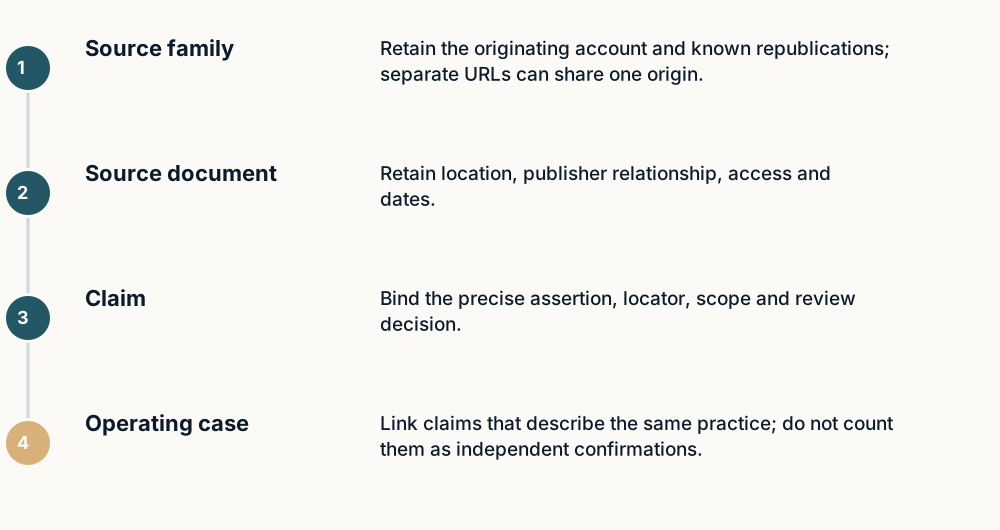
A source, a claim and an operating case are different units
Mayden analytical framework / questions to test, not measured maturity stages
Read the exhibit in text
Source family
Retain the originating account and known republications; separate URLs can share one origin.
Source document
Retain location, publisher relationship, access and dates.
Claim
Bind the precise assertion, locator, scope and review decision.
Operating case
Link claims that describe the same practice; do not count them as independent confirmations.
Basis: conceptual-tool. Unit: Conceptual decision or evidence request. Cutoff: 2026-10-10. Mayden conceptual framework. These questions specify evidence to request; they do not assert that a named organisation has or lacks the practice. This is not a validated instrument or an observed causal sequence.
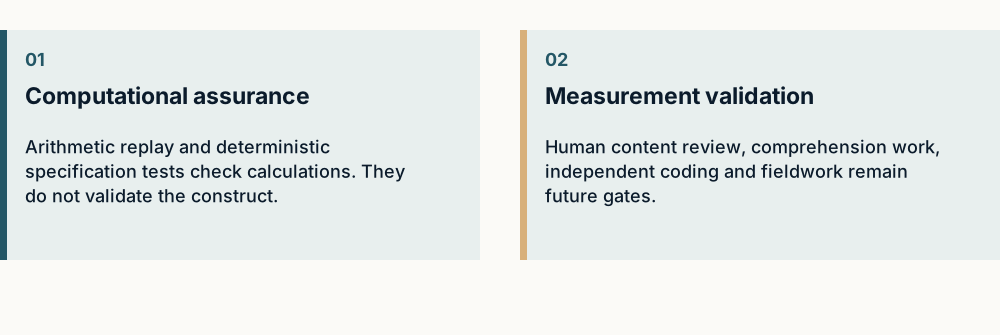
A reproducible calculation does not validate the construct
Mayden analytical framework / questions to test, not measured maturity stages
Read the exhibit in text
Computational assurance
Arithmetic replay and deterministic specification tests check calculations. They do not validate the construct.
Measurement validation
Human content review, comprehension work, independent coding and fieldwork remain future gates.
Basis: conceptual-tool. Unit: Conceptual decision or evidence request. Cutoff: 2026-10-10. Mayden conceptual framework. These questions specify evidence to request; they do not assert that a named organisation has or lacks the practice. This is not a validated instrument or an observed causal sequence.
An index earns trust through its construct, evidence and reproducibility, not its visual precision.
Begin with the claim the number would make
Normalisation makes observations calculable on a chosen scale. It does not establish that components represent the intended construct or deserve their weights. The OECD/JRC handbook exposes such modelling choices; it does not validate Mayden’s dimensions. Handbook on Constructing Composite Indicators: Methodology and User Guide ↗.
Historical public-evidence editions used the strongest qualifying disclosure in each of nine themes, a fixed denominator and equal nominal weights. Arithmetic could be replayed, but one narrow implementation could fill a theme, unknown public evidence contributed no documented points, and access varied. These properties limit enterprise-capability interpretation. The current edition removes individual company scores from active public research.
The future instrument should distinguish a formative composite, reflective subscales and direct descriptive measures. A formative design defines a concept through selected components; high correlation is not automatically desirable. Reflective components need their own model and tests. Neither is validated by a convenient distribution. Conventional Wisdom on Measurement: A Structural Equation Perspective ↗; Best Practices for Developing and Validating Scales for Health, Social, and Behavioral Research: A Primer ↗.
Keep source, claim and operating case separate
A document can support several claims; URLs can repeat one assertion; claims can describe one case; a group can appear through subsidiaries. URL volume is not independent confirmation. Record original assertion, document version, extracted passage, claim, review and release. A provenance graph exposes derivation, not truth. PROV-DM: The PROV Data Model ↗.
Legacy review records are not all bound to exact claim hashes, and some sources lack recorded dates. New controls should surface those gaps without rewriting history as if reviews had occurred. A queue cannot confer eligibility, confirm current operation or manufacture a second reviewer.
Missingness needs a reason: not searched, no qualifying evidence within a declared search, inaccessible source, outside scope or an observed negative finding. A participant instrument also needs unknown and not-applicable responses. Treating every state as zero creates precision about a different question.
Challenge modelling choices without inventing probabilities
The 11 October challenge tested 512 joint weight-corner specifications and 36 ordinal-spacing specifications against frozen v4, alongside a separately labelled baseline reference. Independent replay checked 43,840 specification-record results across 548 nonbaseline choices and 80 records. It verifies tested arithmetic, not source truth or construct validity.
Within the 512 weight choices, 53 of 59 historically ranked records changed position in at least one tested specification. Analysts selected the set; it is not a probability distribution, an exhaustive plausible model space or an error rate. This cannot become a claim that a corresponding percentage of companies was misclassified. Scope, disclosure inequality and intended use remain primary reasons to reconsider public comparison.
Sensitivity also needs source families, case dependence, coding disagreement, missing evidence and operating breadth. Nominal weight can differ from statistical influence when components vary and correlate. Estimating influence in a small selected corpus would not supply correct future weights. Weights and importance in composite indicators: Closing the gap ↗.
Make institutional trust part of the method
The publication model is deliberate. Inspected BCG Applied AI Index and McKinsey State of AI articles use aggregate respondent comparisons. BCG’s Most Innovative Companies 2023 publicly names and ranks firms using a different reputation/financial-performance composite. These observations establish neither client relationships nor universal consultancy policy. BCG AI research ↗; McKinsey AI research ↗; BCG innovation methodology ↗.
Mayden’s accepted direction is public sector research with attributed facts and a future confidential opt-in diagnostic. Previously published data cannot become anonymous. Preserve history and explain the change. Public facts do not imply participation or endorsement.
Appoint a research lead, a consequential-decision reviewer, a correction route and authority to halt unsupported release. The World Bank discontinued Doing Business after data irregularities: institutional standing does not substitute for controls. That case is not causal evidence about Mayden. World Bank statement ↗.
Predeclare intended decisions, units, sampling frame, validation criteria and analysis. Test content, comprehension, coding and role agreement, sector/language comparability and outcomes against simple alternatives. Report attrition and distinguish within-company change from composition or method change. Human appointments, fieldwork and empirical validation remain future gates.
Leadership agenda
Method lead: specify what each item measures and its required evidence.
Release editor: place denominator, period, access limits and assumptions beside each finding.
Programme owner: appoint accountable humans and protect their right to stop publication.
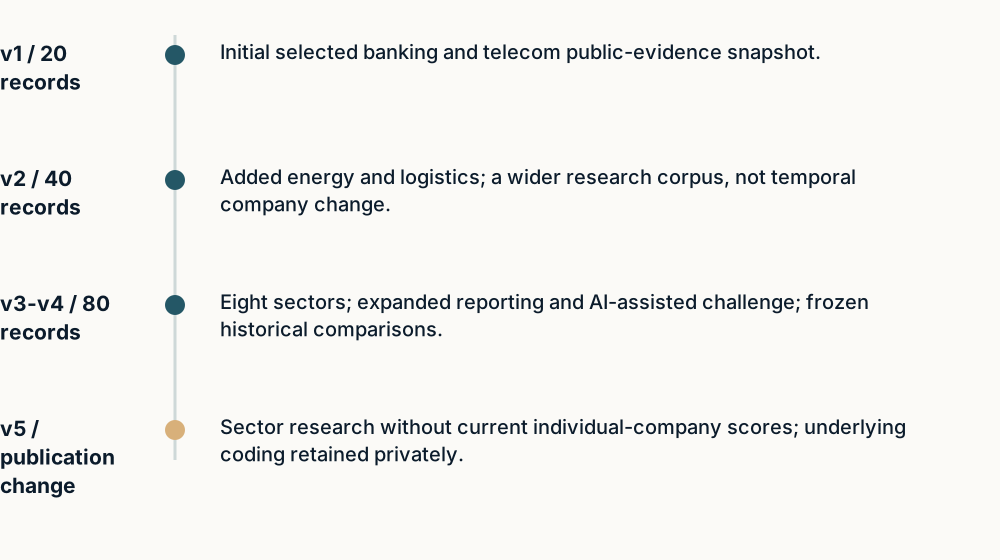
Historic editions answer historic questions
Mayden analytical framework / questions to test, not measured maturity stages
Read the exhibit in text
v1 / 20 records
Initial selected banking and telecom public-evidence snapshot.
v2 / 40 records
Added energy and logistics; a wider research corpus, not temporal company change.
v3-v4 / 80 records
Eight sectors; expanded reporting and AI-assisted challenge; frozen historical comparisons.
v5 / publication change
Sector research without current individual-company scores; underlying coding retained privately.
Basis: research-synthesis. Unit: Frozen publication editions and selected entity records. Cutoff: 2026-10-10. Source: frozen Mayden edition manifests. Cohort expansion and a publication-policy change do not establish a change inside any company. These are release histories, not a performance time series.
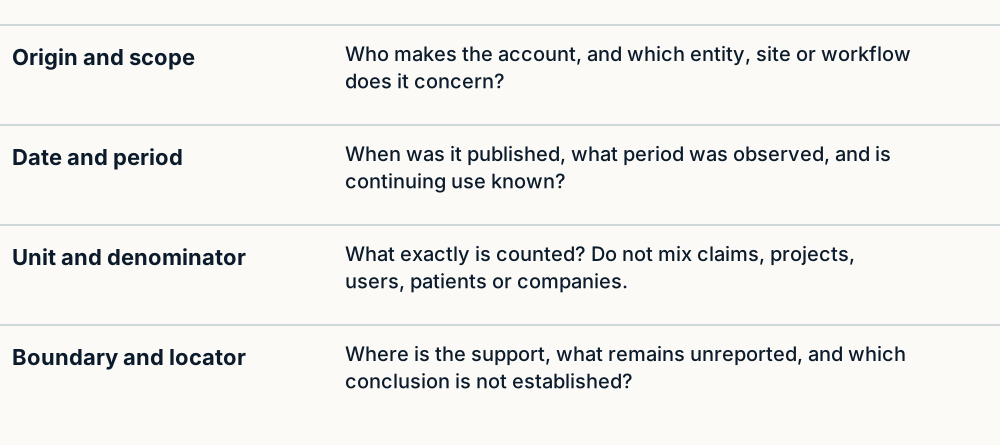
Publish the limits where the result is read
Mayden analytical framework / questions to test, not measured maturity stages
Read the exhibit in text
Origin and scope
Who makes the account, and which entity, site or workflow does it concern?
Date and period
When was it published, what period was observed, and is continuing use known?
Unit and denominator
What exactly is counted? Do not mix claims, projects, users, patients or companies.
Boundary and locator
Where is the support, what remains unreported, and which conclusion is not established?
Basis: conceptual-tool. Unit: Conceptual decision or evidence request. Cutoff: 2026-10-10. Mayden conceptual framework. These questions specify evidence to request; they do not assert that a named organisation has or lacks the practice. This is not a validated instrument or an observed causal sequence.
THE LEADERSHIP AGENDA
Ask for evidence that changes the decision.
01 / Method lead
Evidence to request: specify what each item measures and its required evidence.
02 / Release editor
Evidence to request: place denominator, period, access limits and assumptions beside each finding.
03 / Programme owner
Evidence to request: appoint accountable humans and protect their right to stop publication.
Follow the argument back to its source.
Sources supporting the argument and its examples. Corporate accounts are attributed; inclusion does not imply participation, endorsement or independent operating verification.
S01 / Handbook on Constructing Composite Indicators: Methodology and User Guide
OECD / European Union / EC-JRC · 2008-08-22 · measurement guidance
Locator: Methodological handbook
Open source ↗S02 / Conventional Wisdom on Measurement: A Structural Equation Perspective
Psychological Bulletin · 1991-09 · peer-reviewed-methodological
Locator: Conceptual measurement-model analysis
Open source ↗S03 / Best Practices for Developing and Validating Scales for Health, Social, and Behavioral Research: A Primer
Frontiers in Public Health · 2018-06-11 · peer-reviewed measurement guidance
Locator: Methodological primer
Open source ↗S04 / PROV-DM: The PROV Data Model
W3C · 2013-04-30 · technical-standard
Locator: Normative data-model specification
Open source ↗S05 / Weights and importance in composite indicators: Closing the gap
Ecological Indicators / European Commission JRC · 2017-09 · peer-reviewed-methodological
Locator: Methodological analysis with three case studies
Open source ↗S06 / The Formula for Agentic AI Value: Applied AI Index 2026
BCG · 2026-09-30 · Primary institutional publication; provider account, not independent outcome assurance
Locator: Article, Key Takeaways; survey introduction; Sector comparison
Open source ↗S07 / The State of AI: Global Survey 2025
McKinsey · 2025 · Primary institutional publication; provider account, not independent outcome assurance
Locator: About the research; exhibits
Open source ↗S08 / Most Innovative Companies 2023
BCG · 2023-05 · Primary institutional publication; provider account, not independent outcome assurance
Locator: PDF physical page 7 / printed page 5, Exhibit 3; physical page 27, Methodology
Open source ↗S09 / World Bank Group to Discontinue Doing Business Report
World Bank · 2021-09-16 · Primary institutional publication; provider account, not independent outcome assurance
Locator: Official discontinuation statement
Open source ↗Aggregate chart inputs are available in the current public dataset. The underlying company coding remains private; earlier published calculations are explicitly archived. Download the designed PDF ↓