التقرير الكامل متاح بالإنجليزية في هذا الإصدار. يستند البحث إلى مصادر منشورة، ولا ينشر درجات فردية للشركات.
THE ARGUMENT
- 01
What signal is detected?
Define the event, product or schedule, the site and the employee receiving the result. The denominator might be inspected units, eligible operating areas or manufacturing orders.
- 02
Who receives the result?
Identify the operator or planner who receives the result and the decision they can make. A detected event needs a responsible intervention owner.
- 03
What operating action changes?
Trace the signal to rejection, rework, a changed safety action or an accepted schedule. Retain rejected recommendations and workarounds as well as successful use.
- 04
How are misses and adverse outcomes measured?
Evaluate missed events and false alerts alongside workload, delay and adverse consequences. Match each measure to the process and retain its operating denominator.
THE EXECUTIVE VIEW
Inspection, safety attention and order planning demand different proof at the point of action.
01 / Inspection, safety attention and order planning demand different proof at the point of action.
02 / Trace a quality signal to review, rejection, rework or acceptance; safety prioritisation to an action and the risks it may miss; an order recommendation to the schedule a planner accepts. Each pathway needs its own evidence.
03 / Connect event, data/model version, signal, reviewer, decision and subsequent observation. Preserve accepted and rejected recommendations. The production owner can then decide whether the tool improved the process and whether its boundary should change.
AI-assisted, bounded public-source research. Purposefully selected entity scopes; no company participation, endorsement, independent assurance or population inference implied. Confidential assessment is in development.
Recorded source dates run from 2023-06-13 to 2026-09-23. 2 of 17 qualifying claim records have no recorded publication date. This is not a common observation window or confirmation of continuing use.
The same AI label conceals three operating tasks
Inspection, safety prioritisation and planning change different operating objects.
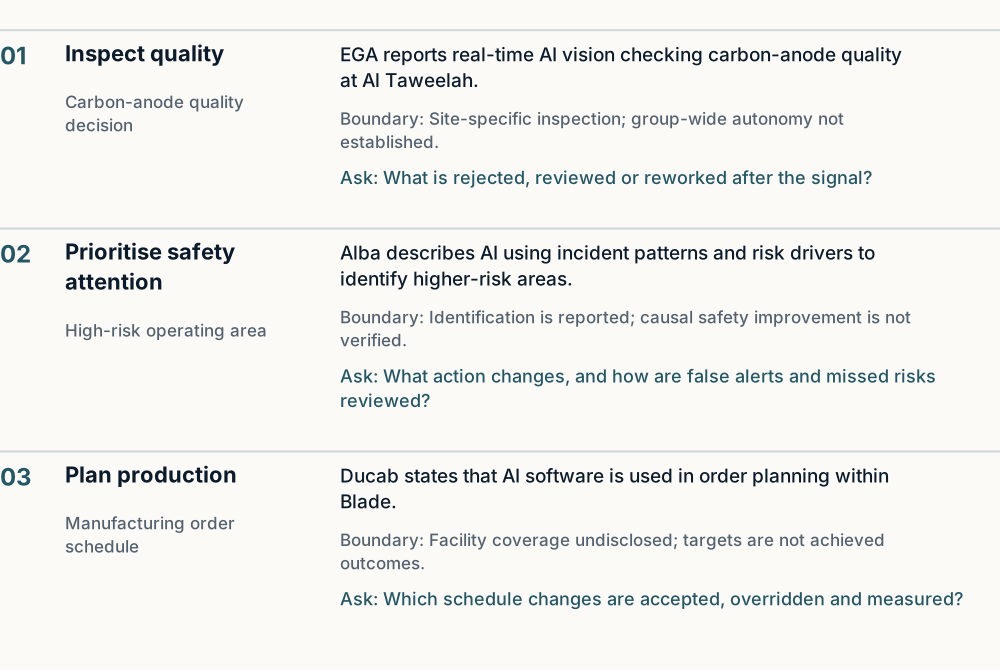
Read the exhibit in text
Inspect quality
Source account: EGA reports real-time AI vision checking carbon-anode quality at Al Taweelah.
Boundary: Site-specific inspection; group-wide autonomy not established.
Question: What is rejected, reviewed or reworked after the signal?
EGA designated Industry 4.0 Global Lighthouse ↗Prioritise safety attention
Source account: Alba describes AI using incident patterns and risk drivers to identify higher-risk areas.
Boundary: Identification is reported; causal safety improvement is not verified.
Question: What action changes, and how are false alerts and missed risks reviewed?
Al Bayan Q1 2026 ↗Plan production
Source account: Ducab states that AI software is used in order planning within Blade.
Boundary: Facility coverage undisclosed; targets are not achieved outcomes.
Question: Which schedule changes are accepted, overridden and measured?
Ducab launches Blade smart factory project ↗Basis: attributed-account. Unit: Separate source-described operating cases. Cutoff: 2026-10-10. Company and supplier accounts are attributed descriptions, not independent assurance. Each row describes a different operating task; no company comparison or rating is intended.
Detection quality and operational consequence must be evaluated together
Mayden analytical framework / questions to test, not measured maturity stages
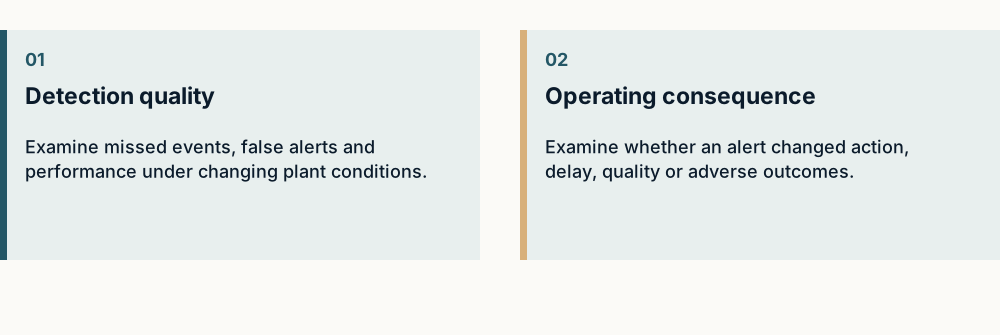
Read the exhibit in text
Detection quality
Examine missed events, false alerts and performance under changing plant conditions.
Operating consequence
Examine whether an alert changed action, delay, quality or adverse outcomes.
Basis: conceptual-tool. Unit: Conceptual decision or evidence request. Cutoff: 2026-10-10. Mayden conceptual framework. These questions specify evidence to request; they do not assert that a named organisation has or lacks the practice. This is not a validated instrument or an observed causal sequence.
Ask for the intervention record, not only the model result
Mayden analytical framework / questions to test, not measured maturity stages
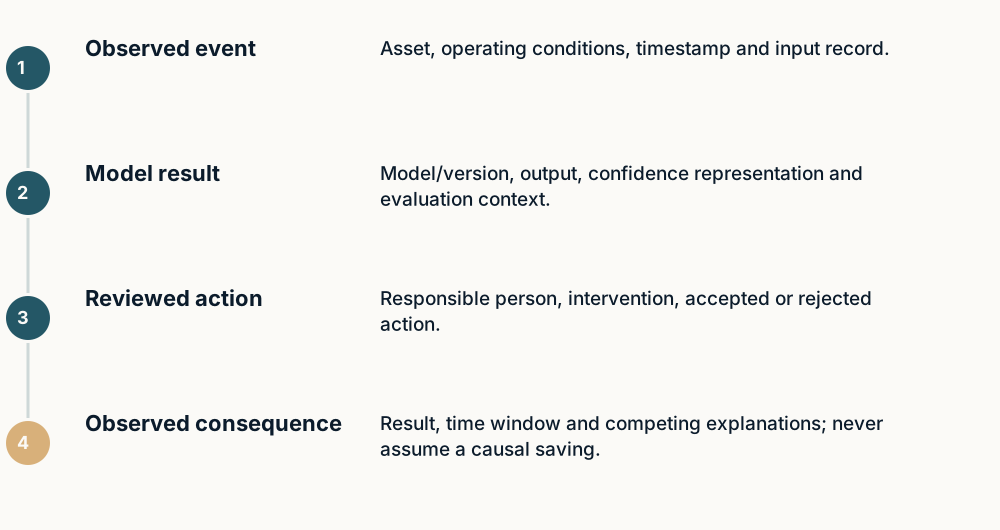
Read the exhibit in text
Observed event
Asset, operating conditions, timestamp and input record.
Model result
Model/version, output, confidence representation and evaluation context.
Reviewed action
Responsible person, intervention, accepted or rejected action.
Observed consequence
Result, time window and competing explanations; never assume a causal saving.
Basis: conceptual-tool. Unit: Conceptual decision or evidence request. Cutoff: 2026-10-10. Mayden conceptual framework. These questions specify evidence to request; they do not assert that a named organisation has or lacks the practice. This is not a validated instrument or an observed causal sequence.
Inspection, safety attention and order planning demand different proof at the point of action.
Factory AI becomes an organisational question when somebody acts on a signal. Inspecting an anode, prioritising safety attention and planning an order are different decisions. A model result alone does not show how the plant changed its work.
Start at the production event
Define the event, product or schedule, the site and the employee receiving the result. The denominator might be inspected units, eligible operating areas or manufacturing orders. Group revenue, model count and announced investment cannot substitute for those operating denominators.
The selected accounts cover different tasks. Read them as examples of what to investigate, not evidence that one manufacturer has a better overall operating model.
Join detection quality to intervention
Trace a quality signal to review, rejection, rework or acceptance; safety prioritisation to an action and the risks it may miss; an order recommendation to the schedule a planner accepts. Each pathway needs its own evidence.
A conceptual evaluation can examine missed events and false alerts alongside delay, workload and adverse consequences. These are proposed inquiry dimensions, not a populated chart of company performance. This review establishes no common numerical threshold.
Attributed operating examples
These separate cases were selected by the operating question, not company standing. The diagram does not imply one connected system.
Inspect quality
EGA reports real-time AI vision checking carbon-anode quality at Al Taweelah. Site-specific inspection; group-wide autonomy not established. The next research question is: What is rejected, reviewed or reworked after the signal?
Source: EGA designated Industry 4.0 Global Lighthouse ↗.
Prioritise safety attention
Alba describes AI using incident patterns and risk drivers to identify higher-risk areas. Identification is reported; causal safety improvement is not verified. The next research question is: What action changes, and how are false alerts and missed risks reviewed?
Source: Al Bayan Q1 2026 ↗.
Plan production
Ducab states that AI software is used in order planning within Blade. Facility coverage undisclosed; targets are not achieved outcomes. The next research question is: Which schedule changes are accepted, overridden and measured?
Source: Ducab launches Blade smart factory project ↗.
Include the people absorbing the change
Operators can reveal checking, workarounds and new tasks that leadership does not see. OECD employer and worker surveys illustrate sector-specific questions and multiple perspectives. Their manufacturing and finance samples came from seven non-GCC countries; the reported perceptions are not a local causal effect estimate. The impact of AI on the workplace: Main findings from the OECD AI surveys of employers and workers ↗.
Record who is trained, who handles uncertainty and what happens during unavailability. An intervention needs an owner even when the model performs well. Keep planned pilots, completed models and sustained production use distinct.
Make the intervention record the management unit
Connect event, data/model version, signal, reviewer, decision and subsequent observation. Preserve accepted and rejected recommendations. The production owner can then decide whether the tool improved the process and whether its boundary should change.
A future benchmark must retain site and product scope, workload shifts and process changes. Otherwise a repeated company questionnaire may appear to show progress while describing another factory or another task.
Leadership agenda
Plant owner: define the process, event and output denominator.
Operators: identify checking, false alerts, missed events and workarounds.
Evaluation: connect outputs to interventions and observed consequences.
Scope and reading boundaries
The source corpus contains 80 purposefully selected entity records across eight sectors, ten per sector. Headquarters markets are Saudi Arabia, the UAE, Qatar, Kuwait and Bahrain; Oman is outside this edition. Groups, subsidiaries and specific operations have different scopes. This is not a representative sample. Source cutoff: 10 October 2026; publication edition: 11 October 2026.
Source extraction and challenge were AI-assisted, not independent human assurance or verification of current operations. Source visibility is not adoption prevalence. Unreported details are unresolved questions, not absent capabilities. Named examples imply neither participation, endorsement, confidential access nor a Mayden client relationship.
A CLOSER LOOK
Inspect quality
Carbon-anode quality decision
EGA reports implemented AI vision checking carbon-anode quality in real time.
Boundary. Site-specific inspection; group-wide autonomy not established.
Source date. 2025-01-15
Locator. Body paragraph describing real-time carbon-anode quality assessment Inspect source ↗
The leadership question
What is rejected, reviewed or reworked after the signal?
Site-specific inspection; group-wide autonomy not established.
Prioritise safety attention
High-risk operating area
Alba describes deployed AI using incident patterns and risk drivers to identify high-risk operating areas.
Boundary. Identification is reported; causal safety improvement is not verified.
Source date. 2026
Locator. Physical 24, printed 46–47, AI safety article Inspect source ↗
The leadership question
What action changes, and how are false alerts and missed risks reviewed?
Identification is reported; causal safety improvement is not verified.
Plan production
Manufacturing order schedule
Ducab states that AI software is used in manufacturing order planning within Blade.
Boundary. Facility coverage undisclosed; targets are not achieved outcomes.
Source date. 2023-06-13
Locator. Body paragraph on AI software and planning orders Inspect source ↗
The leadership question
Which schedule changes are accepted, overridden and measured?
Facility coverage undisclosed; targets are not achieved outcomes.
THE LEADERSHIP AGENDA
Ask for evidence that changes the decision.
01 / Plant owner
Evidence to request: define the process, event and output denominator.
02 / Operators
Evidence to request: identify checking, false alerts, missed events and workarounds.
03 / Evaluation
Evidence to request: connect outputs to interventions and observed consequences.
Follow the argument back to its source.
Sources supporting the argument and its examples. Corporate accounts are attributed; inclusion does not imply participation, endorsement or independent operating verification.
S01 / EGA designated Industry 4.0 Global Lighthouse
EGA · 2025-01-15 · corporate-operating-announcement
Locator: Body paragraph describing real-time carbon-anode quality assessment
Open source ↗S02 / Al Bayan Q1 2026
Alba · 2026 · company-magazine
Locator: Physical 24, printed 46–47, AI safety article
Open source ↗S03 / Ducab launches Blade smart factory project
Ducab · 2023-06-13 · corporate-operating-announcement
Locator: Body paragraph on AI software and planning orders
Open source ↗S04 / The impact of AI on the workplace: Main findings from the OECD AI surveys of employers and workers
OECD Social, Employment and Migration Working Papers · 2023-03-22 · official-original-survey
Locator: Separate employer telephone and worker online-panel surveys
Open source ↗Aggregate chart inputs are available in the current public dataset. The underlying company coding remains private; earlier published calculations are explicitly archived. Download the designed PDF ↓