التقرير الكامل متاح بالإنجليزية في هذا الإصدار. يستند البحث إلى مصادر منشورة، ولا ينشر درجات فردية للشركات.

THE ARGUMENT
- 01
What is being predicted?
Specify the equipment, event or process variable and the named asset. Predicting a maintenance need does not execute the intervention.
- 02
What can change a physical process?
Identify the observations entering the model, how the output is used, who authorises change and what constrains it. Keep source-described steps separate from proposed questions.
- 03
Who selects the setpoint?
Distinguish an engineer choosing a setpoint from a system permitted to adjust a process. Record the operating envelope, intervention owner and fallback.
- 04
What operating evidence should survive review?
The asset owner should state the decision and constraints. Engineering should show intervention history and responses to unusual conditions.
THE EXECUTIVE VIEW
Predicting maintenance, adjusting a process and exploring scenarios confer different operational authority.
01 / Predicting maintenance, adjusting a process and exploring scenarios confer different operational authority.
02 / Identify the observations entering the model, how the output is used, who authorises change and what constrains it. Keep source-described steps separate from proposed questions. A conceptual diagram must not imply an undisclosed connection.
03 / The asset owner should state the decision and constraints. Engineering should show intervention history and responses to unusual conditions. Operations and finance should reconcile benefit claims with checking work, maintenance, costs and observed output. Expansion should follow that record.
AI-assisted, bounded public-source research. Purposefully selected entity scopes; no company participation, endorsement, independent assurance or population inference implied. Confidential assessment is in development.
Recorded source dates run from 2023-03-08 to 2026-07-06. 8 of 30 qualifying claim records have no recorded publication date. This is not a common observation window or confirmation of continuing use.
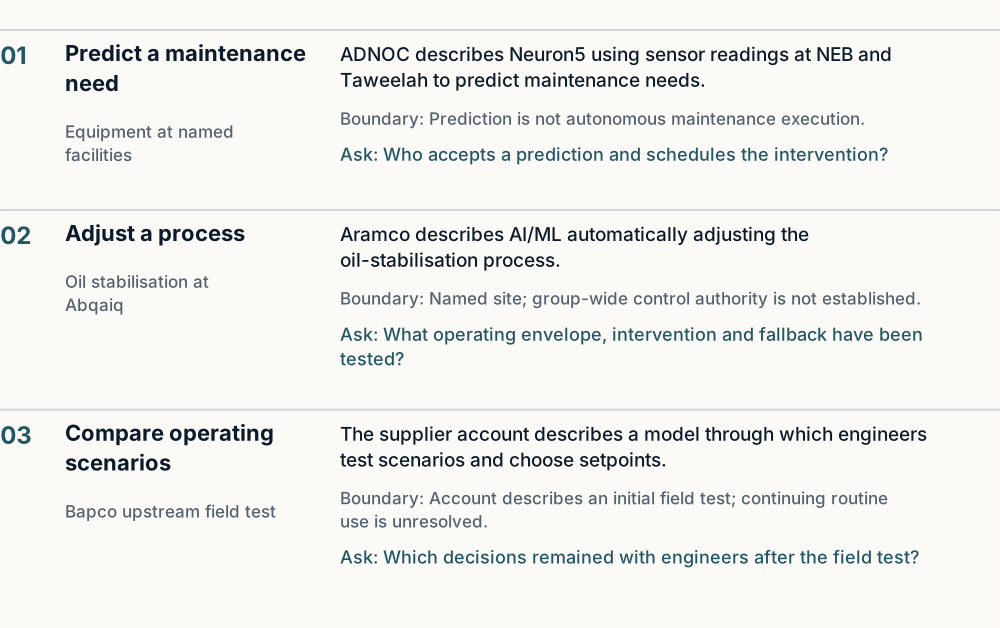
Prediction, automatic adjustment and scenario testing are not equivalent
Different decision arrangements in selected source accounts; no ordering implies that more autonomy is better.
Read the exhibit in text
Predict a maintenance need
Source account: ADNOC describes Neuron5 using sensor readings at NEB and Taweelah to predict maintenance needs.
Boundary: Prediction is not autonomous maintenance execution.
Question: Who accepts a prediction and schedules the intervention?
ADNOC Deploys Pioneering AI-Enabled Process Optimization Technology ↗Adjust a process
Source account: Aramco describes AI/ML automatically adjusting the oil-stabilisation process.
Boundary: Named site; group-wide control authority is not established.
Question: What operating envelope, intervention and fallback have been tested?
AI and Big Data ↗Compare operating scenarios
Source account: The supplier account describes a model through which engineers test scenarios and choose setpoints.
Boundary: Account describes an initial field test; continuing routine use is unresolved.
Question: Which decisions remained with engineers after the field test?
Geminus AI, Bapco Energies and SLB to Deploy Physics-Native AI to Optimize Bahrain’s Energy Infrastructure ↗Basis: attributed-account. Unit: Separate source-described operating cases. Cutoff: 2026-10-10. Company and supplier accounts are attributed descriptions, not independent assurance. Each row describes a different operating task; no company comparison or rating is intended.
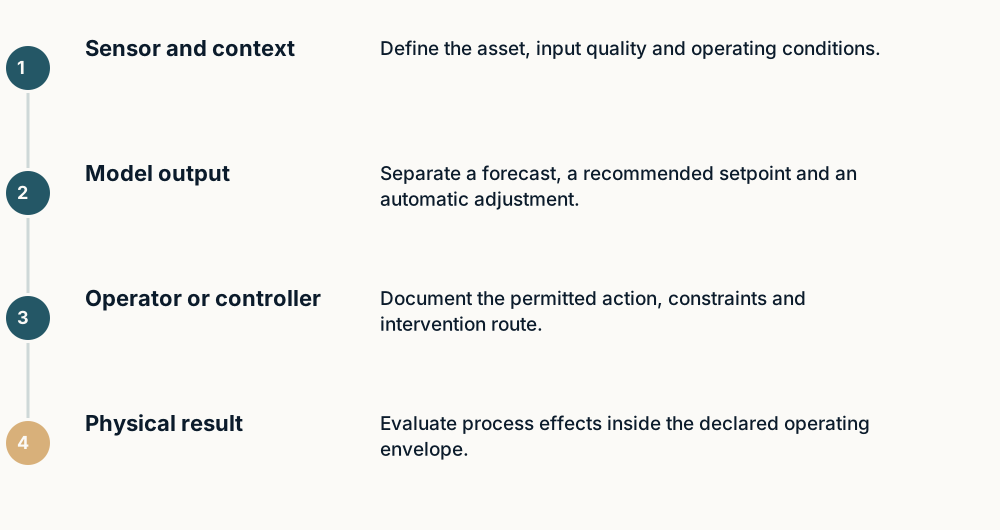
Follow a process change through its operating envelope
Mayden analytical framework / questions to test, not measured maturity stages
Read the exhibit in text
Sensor and context
Define the asset, input quality and operating conditions.
Model output
Separate a forecast, a recommended setpoint and an automatic adjustment.
Operator or controller
Document the permitted action, constraints and intervention route.
Physical result
Evaluate process effects inside the declared operating envelope.
Basis: conceptual-tool. Unit: Conceptual decision or evidence request. Cutoff: 2026-10-10. Mayden conceptual framework. These questions specify evidence to request; they do not assert that a named organisation has or lacks the practice. This is not a validated instrument or an observed causal sequence.
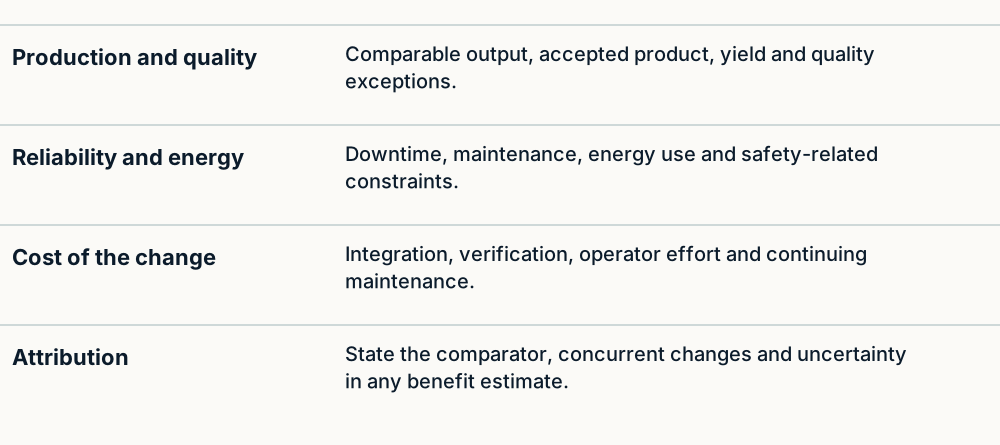
A benefit account must include what the plant had to absorb
Mayden analytical framework / questions to test, not measured maturity stages
Read the exhibit in text
Production and quality
Comparable output, accepted product, yield and quality exceptions.
Reliability and energy
Downtime, maintenance, energy use and safety-related constraints.
Cost of the change
Integration, verification, operator effort and continuing maintenance.
Attribution
State the comparator, concurrent changes and uncertainty in any benefit estimate.
Basis: conceptual-tool. Unit: Conceptual decision or evidence request. Cutoff: 2026-10-10. Mayden conceptual framework. These questions specify evidence to request; they do not assert that a named organisation has or lacks the practice. This is not a validated instrument or an observed causal sequence.
Predicting maintenance, adjusting a process and exploring scenarios confer different operational authority.
A prediction, a process adjustment and an engineer’s scenario analysis are different forms of work. In energy and utilities, the point of action may affect a physical asset. The useful question is what the system can change, within which operating envelope, and who remains accountable.
Locate the asset and decision
Begin at the named plant, equipment class or engineering workflow. One facility does not establish group-wide coverage. A maintenance prediction can inform planning without executing maintenance. A scenario tool can help engineers choose setpoints while leaving authority with them.
Record the source’s relationship to the operation. An issuer account and supplier account can be informative; neither is automatically independent verification of continuing use or achieved benefit.
Inspect the control boundary
Identify the observations entering the model, how the output is used, who authorises change and what constrains it. Keep source-described steps separate from proposed questions. A conceptual diagram must not imply an undisclosed connection.
Review intervention and fallback evidence within the operating envelope. This report offers a research structure; it does not assess process safety, certify a control system or replace engineering assurance.
Attributed operating examples
These separate cases were selected by the operating question, not company standing. The diagram does not imply one connected system.
Predict a maintenance need
ADNOC describes Neuron5 using sensor readings at NEB and Taweelah to predict maintenance needs. Prediction is not autonomous maintenance execution. The next research question is: Who accepts a prediction and schedules the intervention?
Source: ADNOC Deploys Pioneering AI-Enabled Process Optimization Technology ↗.
Adjust a process
Aramco describes AI/ML automatically adjusting the oil-stabilisation process. Named site; group-wide control authority is not established. The next research question is: What operating envelope, intervention and fallback have been tested?
Source: AI and Big Data ↗.
Compare operating scenarios
The supplier account describes a model through which engineers test scenarios and choose setpoints. Supplier account of an initial field test; continuing routine use unresolved. The next research question is: Which decisions remained with engineers after the field test?
Build a complete benefit account
Maintenance prediction might be evaluated against intervention decisions and downtime; process adjustment against output, quality, energy and constraints; engineering support against accepted decisions and verification time. Record baseline, operating conditions and period before combining results.
A technology label or projected target does not establish benefit. The productivity J-curve literature describes how complementary investment can delay measured gains; it does not prove that an AI investment will repay its costs. The Productivity J-Curve: How Intangibles Complement General Purpose Technologies ↗.
Decide what justifies the next boundary
The asset owner should state the decision and constraints. Engineering should show intervention history and responses to unusual conditions. Operations and finance should reconcile benefit claims with checking work, maintenance, costs and observed output. Expansion should follow that record.
For the eventual private study, source publication date and confirmation of continuing use must be separate fields. A historic implementation remains useful, while a current-operation claim needs dated evidence of its own.
Leadership agenda
Asset owner: specify the site, operating envelope and authority.
Engineering: inspect an actual intervention and tested fallback.
Operations and finance: reconcile output, quality, energy, downtime and full delivery cost.
Scope and reading boundaries
The source corpus contains 80 purposefully selected entity records across eight sectors, ten per sector. Headquarters markets are Saudi Arabia, the UAE, Qatar, Kuwait and Bahrain; Oman is outside this edition. Groups, subsidiaries and specific operations have different scopes. This is not a representative sample. Source cutoff: 10 October 2026; publication edition: 11 October 2026.
Source extraction and challenge were AI-assisted, not independent human assurance or verification of current operations. Source visibility is not adoption prevalence. Unreported details are unresolved questions, not absent capabilities. Named examples imply neither participation, endorsement, confidential access nor a Mayden client relationship.
A CLOSER LOOK
Predict a maintenance need
Equipment at named facilities
Neuron5 monitors equipment at NEB and Taweelah using sensor readings to predict maintenance needs.
Boundary. Prediction is not autonomous maintenance execution.
Source date. 2024-08-27
Locator. Release paragraphs1–5 Inspect source ↗
The leadership question
Who accepts a prediction and schedules the intervention?
Prediction is not autonomous maintenance execution.
Adjust a process
Oil stabilisation at Abqaiq
At Abqaiq, AI/ML automatically adjusts the oil-stabilization process.
Boundary. Named site; group-wide control authority is not established.
Source date. Undated
Locator. Abqaiq Plants Inspect source ↗
The leadership question
What operating envelope, intervention and fallback have been tested?
Named site; group-wide control authority is not established.
Compare operating scenarios
Bapco upstream field test
The supplier account describes an initial field test in which engineers test scenarios and choose network setpoints.
Boundary. Account describes an initial field test; continuing routine use is unresolved.
Source date. 2026-04-14
Locator. Engineering what-if paragraph Inspect source ↗
The leadership question
Which decisions remained with engineers after the field test?
Account describes an initial field test; continuing routine use is unresolved.
THE LEADERSHIP AGENDA
Ask for evidence that changes the decision.
01 / Asset owner
Evidence to request: specify the site, operating envelope and authority.
02 / Engineering
Evidence to request: inspect an actual intervention and tested fallback.
03 / Operations and finance
Evidence to request: reconcile output, quality, energy, downtime and full delivery cost.
Follow the argument back to its source.
Sources supporting the argument and its examples. Corporate accounts are attributed; inclusion does not imply participation, endorsement or independent operating verification.
S01 / ADNOC Deploys Pioneering AI-Enabled Process Optimization Technology
ADNOC · 2024-08-27 · corporate-release
Locator: Release paragraphs1–5
Open source ↗S03 / Geminus AI, Bapco Energies and SLB to Deploy Physics-Native AI to Optimize Bahrain’s Energy Infrastructure
Geminus AI release carried by Automation.com · 2026-04-14 · company-issued-syndication
Locator: Engineering what-if paragraph
Open source ↗S04 / The Productivity J-Curve: How Intangibles Complement General Purpose Technologies
NBER; American Economic Journal: Macroeconomics 13(1), 2021 · 2021-01 · peer-reviewed theory and empirical analysis
Locator: Economic model and historical empirical analysis
Open source ↗Aggregate chart inputs are available in the current public dataset. The underlying company coding remains private; earlier published calculations are explicitly archived. Download the designed PDF ↓