التقرير الكامل متاح بالإنجليزية في هذا الإصدار. يستند البحث إلى مصادر منشورة، ولا ينشر درجات فردية للشركات.

THE ARGUMENT
- 01
Which recurring work changes?
Identify a recurring work unit, its users and the accepted result. A demonstration or purchased licence does not establish a changed operating model.
- 02
Who can act, intervene and stop?
State the permitted action, accountable owner, intervention rights and stopping conditions. Greater autonomy is not automatically a better operating design.
- 03
What evidence establishes value?
Keep practices, outcomes and evidence separate. Evaluate accepted work alongside quality, verification, rework, cost and an appropriate comparison.
- 04
What can a benchmark compare?
Compare defined scopes using a tested construct and suitable evidence. Public disclosures cannot be converted into confidential participant norms.
THE EXECUTIVE VIEW
Define the changed work before judging the enterprise.
01 / Define a workflow, responsible decision owner and evidence of repeated useful work. AI-native is Mayden’s proposed organisational construct, not a status established by purchasing technology.
02 / Keep operating practices, outcomes and supporting evidence separate. Combining them too early can reward confident disclosure rather than useful change.
03 / Public research informs this design. A confidential assessment is in development and must pass human and empirical gates before supporting benchmark claims.
AI-assisted, bounded public-source research. Purposefully selected entity scopes; no company participation, endorsement, independent assurance or population inference implied. Confidential assessment is in development.
Recorded source dates run from 2019-05-14 to 2026-10-01. 79 of 224 qualifying claim records have no recorded publication date. This is not a common observation window or confirmation of continuing use.
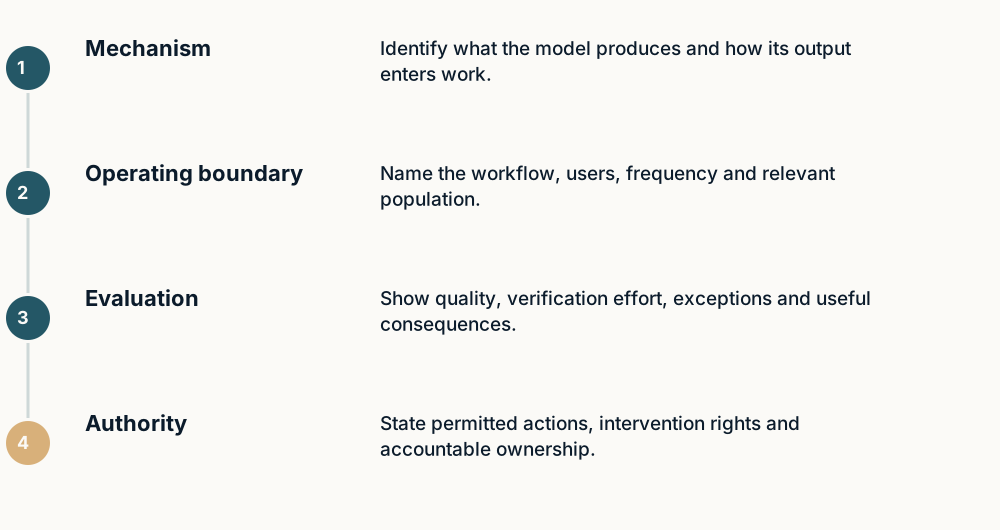
A workflow claim needs four different tests
Mayden analytical framework / questions to test, not measured maturity stages
Read the exhibit in text
Mechanism
Identify what the model produces and how its output enters work.
Operating boundary
Name the workflow, users, frequency and relevant population.
Evaluation
Show quality, verification effort, exceptions and useful consequences.
Authority
State permitted actions, intervention rights and accountable ownership.
Basis: conceptual-tool. Unit: Conceptual decision or evidence request. Cutoff: 2026-10-10. Mayden conceptual framework. These questions specify evidence to request; they do not assert that a named organisation has or lacks the practice. This is not a validated instrument or an observed causal sequence.
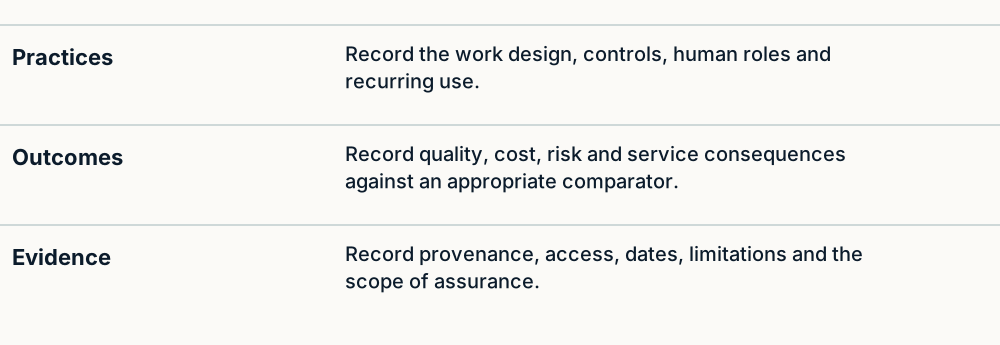
Keep capability, outcomes and evidence on separate ledgers
Mayden analytical framework / questions to test, not measured maturity stages
Read the exhibit in text
Practices
Record the work design, controls, human roles and recurring use.
Outcomes
Record quality, cost, risk and service consequences against an appropriate comparator.
Evidence
Record provenance, access, dates, limitations and the scope of assurance.
Basis: conceptual-tool. Unit: Conceptual decision or evidence request. Cutoff: 2026-10-10. Mayden conceptual framework. These questions specify evidence to request; they do not assert that a named organisation has or lacks the practice. This is not a validated instrument or an observed causal sequence.
Define the changed work before judging the enterprise.
Define the changed work
Mayden proposes an AI-native enterprise as one that repeatedly converts AI capability into useful, accountable work across a defined organisational scope. This working definition concerns recurring decisions, workflows, responsibilities and learning. It is a research proposition, not an empirically validated classification.
Start with a resolved service request, reviewed clinical note, accepted production schedule or authorised maintenance decision. State what AI contributes and where the work finishes. A demonstration shows that an output can be produced under particular conditions. A changed operating model needs a repeatable relationship between output, people and result.
Counterexamples sharpen the definition. Buying licences establishes availability, not active use. A specialised model can be valuable without transforming an organisation. Restricting automation can reflect sound judgement; maximum autonomy is not the objective.
Test the mechanism and work boundary
AI research does not deliver one transferable enterprise effect. A customer-support study found gains differing by experience; writing experiments and a bounded consulting exercise study other work. They identify mechanisms and questions but cannot be averaged into an expected return for a Gulf enterprise. Generative AI at Work ↗; Experimental evidence on the productivity effects of generative artificial intelligence ↗; Navigating the Jagged Technological Frontier ↗.
Evidence complicating the positive story belongs in the same review. An early-2025 developer study found slower completion in its small selected setting despite perceived speed-up. A subsequent methods update describes selection and time-measurement problems in newer estimates. This warns about transfer and measurement; it is not a universal conclusion about developers. Measuring the Impact of Early-2025 AI on Experienced Open-Source Developer Productivity ↗; We are Changing our Developer Productivity Experiment Design ↗.
Define eligible work, observation period, comparison and acceptance criterion before evaluating results. Include rejected outputs, checking, interruptions and the people absorbing change. A faster component can shift work elsewhere.
Keep three evidence ledgers
The practice ledger records workflow, scope, accountable role, permissions, frequency and coverage. The outcome ledger records quality, time, throughput, cost, service and adverse effects, together with the comparison supporting interpretation. The evidence ledger records respondent role, document or observation, date, locator, provenance, contradictions and review.
Connect the ledgers without collapsing them into one number. A documented disappointing result is scientifically valuable. A reported saving without a baseline may merit further study. Strong source access does not establish effectiveness; limited public disclosure does not establish a weak company.
Nine candidate themes organise the inquiry: AI in core work; workforce; ecosystem; interfaces and automation; decision lineage; experimentation; autonomy and operating model; organisational knowledge; governance. They are hypotheses about a useful composite, not interchangeable symptoms of a proven latent trait. Internal consistency alone would not validate them. Conventional Wisdom on Measurement: A Structural Equation Perspective ↗; Handbook on Constructing Composite Indicators: Methodology and User Guide ↗.
Build the benchmark around a useful decision
A private report should help executives decide what to improve, test, stop or verify. It should state scope, show disagreements and propose a bounded action with an owner and measure. It must remain useful even if research does not support a single headline score.
Development requires content review, bilingual cognitive work, feasibility testing, independent coding and empirical evaluation for declared purposes. Sample requirements follow the construct, comparisons and precision, not a convenient target. A 40–60-company feasibility plan is a capacity assumption, not validation power. Best Practices for Developing and Validating Scales for Health, Social, and Behavioral Research: A Primer ↗.
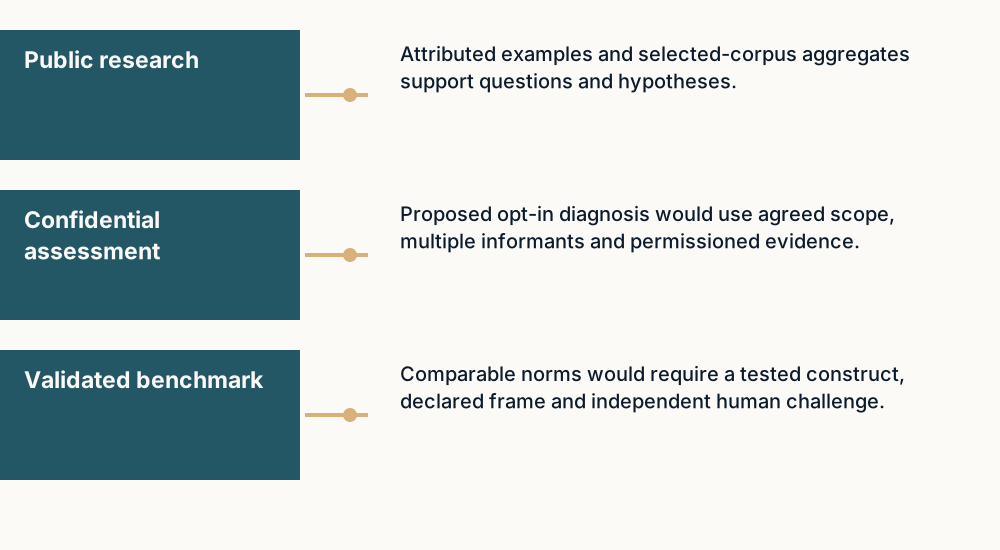
Public research describes source-backed examples and limits of a collection. A future participant study would examine permissioned evidence over a defined period. Their scales cannot be converted, and the public series cannot certify enterprise capability.
Leadership agenda
Executive sponsor: identify the recurring decision the assessment should improve.
Method lead: specify the construct and evidence needed for that use.
Operating team: retain outcomes, interventions and uncertainty alongside successes.
Scope and reading boundaries
The source corpus contains 80 purposefully selected entity records across eight sectors, ten per sector. Headquarters markets are Saudi Arabia, the UAE, Qatar, Kuwait and Bahrain; Oman is outside this edition. Groups, subsidiaries and specific operations have different scopes. This is not a representative sample. Source cutoff: 10 October 2026; publication edition: 11 October 2026.
Source extraction and challenge were AI-assisted, not independent human assurance or verification of current operations. Source visibility is not adoption prevalence. Unreported details are unresolved questions, not absent capabilities. Named examples imply neither participation, endorsement, confidential access nor a Mayden client relationship.
A public source and a private assessment answer different questions
Mayden analytical framework / questions to test, not measured maturity stages
Read the exhibit in text
Public research
Attributed examples and selected-corpus aggregates support questions and hypotheses.
Confidential assessment
Proposed opt-in diagnosis would use agreed scope, multiple informants and permissioned evidence.
Validated benchmark
Comparable norms would require a tested construct, declared frame and independent human challenge.
Basis: conceptual-tool. Unit: Conceptual decision or evidence request. Cutoff: 2026-10-10. Mayden conceptual framework. These questions specify evidence to request; they do not assert that a named organisation has or lacks the practice. This is not a validated instrument or an observed causal sequence.
THE LEADERSHIP AGENDA
Ask for evidence that changes the decision.
01 / Executive sponsor
Evidence to request: identify the recurring decision the assessment should improve.
02 / Method lead
Evidence to request: specify the construct and evidence needed for that use.
03 / Operating team
Evidence to request: retain outcomes, interventions and uncertainty alongside successes.
Follow the argument back to its source.
Sources supporting the argument and its examples. Corporate accounts are attributed; inclusion does not imply participation, endorsement or independent operating verification.
S01 / Generative AI at Work
Quarterly Journal of Economics · 2025-02-04 · peer-reviewed empirical
Locator: Staggered workplace rollout; observational causal design
Open source ↗S02 / Experimental evidence on the productivity effects of generative artificial intelligence
Science · 2023-07-13 · peer-reviewed experiment
Locator: Preregistered randomized online experiment
Open source ↗S03 / Navigating the Jagged Technological Frontier
Harvard Business School working paper 24-013 · 2023-09 · working-paper experiment
Locator: Randomized field experiment
Open source ↗S04 / Measuring the Impact of Early-2025 AI on Experienced Open-Source Developer Productivity
METR · 2025-07-10 · original experiment
Locator: Task-randomized controlled trial
Open source ↗S05 / We are Changing our Developer Productivity Experiment Design
METR · 2026-02-24 · original follow-up methods report
Locator: Follow-up randomized study; methodological disclosure
Open source ↗S06 / Conventional Wisdom on Measurement: A Structural Equation Perspective
Psychological Bulletin · 1991-09 · peer-reviewed-methodological
Locator: Conceptual measurement-model analysis
Open source ↗S07 / Handbook on Constructing Composite Indicators: Methodology and User Guide
OECD / European Union / EC-JRC · 2008-08-22 · measurement guidance
Locator: Methodological handbook
Open source ↗S08 / Best Practices for Developing and Validating Scales for Health, Social, and Behavioral Research: A Primer
Frontiers in Public Health · 2018-06-11 · peer-reviewed measurement guidance
Locator: Methodological primer
Open source ↗Aggregate chart inputs are available in the current public dataset. The underlying company coding remains private; earlier published calculations are explicitly archived. Download the designed PDF ↓